
India's labour codes: what they mean and how to comply
India's four labour codes are in force. This guide explains the definition of wages, the 50% rule, gratuity for fixed-term staff, the social-security changes, and the practical steps employers should take before enforcement tightens.
By Knighthood Team
Published 28 January 2026
Updated 24 August 2026
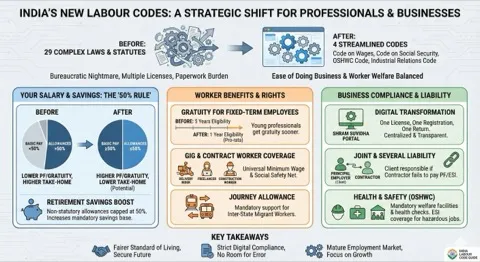
India has consolidated 29 separate labour statutes into four codes. For employers this is the biggest change to how work is regulated in decades — it changes what counts as wages, how statutory costs are calculated, and what compliance looks like day to day. This guide explains what has changed, what is already binding, and what to do about it.
The four codes
- The Code on Wages, 2019 — standardises wages and minimum-wage rights across sectors.
- The Code on Social Security, 2020 — extends social-security protection (PF, pension, insurance) to gig, platform and contract workers.
- The Occupational Safety, Health and Working Conditions Code, 2020 — a single framework for workplace safety and health.
- The Industrial Relations Code, 2020 — consolidates rules on unions, disputes and service conditions.
Are the codes active yet?
The codes are central legislation and are in force. The Code on Wages, 2019 and the other codes were brought into effect on 21 November 2025 by the central government. Because labour is a concurrent subject, the central codes define the framework while state governments notify the rules, thresholds and enforcement mechanics.
Two consequences follow:
- The parts of the codes that are central and structural — most importantly the definition of wages — apply now, state notification or not.
- State-level procedures are still being issued. Existing state notifications for minimum wages and the like remain valid in the meantime under the law’s savings clause.
Treating the codes as “not applicable yet” is the wrong reading. The risk is not a sudden fine; it is the silent gap between what your payroll assumes and what the law now says.
The change that affects everything: the definition of wages
The most consequential change is a uniform definition of “wages”. Wages now include basic pay, dearness allowance and retaining allowance — and the room to design salary structures heavily tilted toward allowances has been capped.
The 50% rule
If allowances and variable components exceed 50% of total remuneration, the excess is reclassified as wages. Because PF, gratuity, pension and termination compensation are all calculated on wages, this moves more of the cost into statutory contributions. A salary structure designed under the old rules may now be under-providing on PF and gratuity even though the employee’s take-home has not changed.
What else changed for employees and employers
- Fixed-term employees become eligible for gratuity after one year of service (previously gratuity was largely limited to continuous service).
- Universal minimum-wage and social-security rights now extend beyond permanent staff to contract, gig and platform workers.
- One registration, one return: the administrative model shifts to a single electronic registration and a single annual consolidated return, replacing multiple state filings.
- A new inspection model moves from routine on-site audits to risk-based inspections, which rewards employers whose records are clean and current.
Social security: PF, pension and insurance
The statutory framework on provident fund continues under the Code on Social Security. The essentials employers must already handle:
- EPF — the employee and employer each contribute 12% of basic wages plus dearness allowance, subject to the statutory wage ceiling.
- Employees’ Pension Scheme (EPS) — the PF account also carries a pension entitlement; a minimum monthly pension applies to pensioners covered by the scheme.
- EDLI — the insurance layer on PF that provides a fixed benefit to the family in the event of death in service, up to the notified limit.
- ESI — employer contribution on wages within the eligibility threshold, where applicable.
The exact figures and ceilings are the same ones the labour-cost calculator applies, and the security guard cost breakdown shows them on a real wage.
An implementation roadmap for employers
- Re-run every wage structure through the new definition. The basic + DA combination must not let allowances exceed the 50% line. If they do, the excess becomes wages with statutory consequences.
- Recheck statutory contributions on the reclassified wage — PF, gratuity, pension and leave encashment bases all move.
- Review contract labour — the rules on fixed-term and contract staff changed (gratuity eligibility, social-security coverage); update the contract paperwork accordingly.
- Update payroll systems so registrations and the single annual return run against the new definitions, and so wage changes are reflected the month they apply.
- Watch state notifications — the state rules (minimum-wage floors, portals, thresholds) are rolling in; an employment compliance partner that already runs payroll for you applies each change when it takes effect. See payroll services and the compliance guide.
The bottom line
The labour codes are law now. The practical exposure is in payroll structures that were designed under the old rules and have not been reworked. The fix is not complicated — a single, well-run compliance and payroll discipline — but it is overdue. Rework wages to the new definition, confirm the statutory calculations, and let someone accountable run the filings.
Send the requirement
If this post points at a decision you are close to making, send us the scope — sites, roles and shifts — and we will confirm the licence, supervision and commercial position for your situation.
Discuss your requirement