
India's Labour Codes 2025-2026 — Impact & Compliance Guide for Facility Management & Security Services
India's four Labour Codes for facility and security services: the 50% rule, wage restructuring, fixed-term employment and a phased compliance roadmap.
By Knighthood Team
Published 13 December 2025
Updated 24 August 2026
A comprehensive impact and compliance guide for facility management and security services.
At a glance
- On November 21, 2025, India officially notified four comprehensive Labour Codes, consolidating 29 central labour laws into a unified framework.
- For FM and security companies, this triggers immediate wage restructuring costs: employer statutory obligations increase by 60-66%.
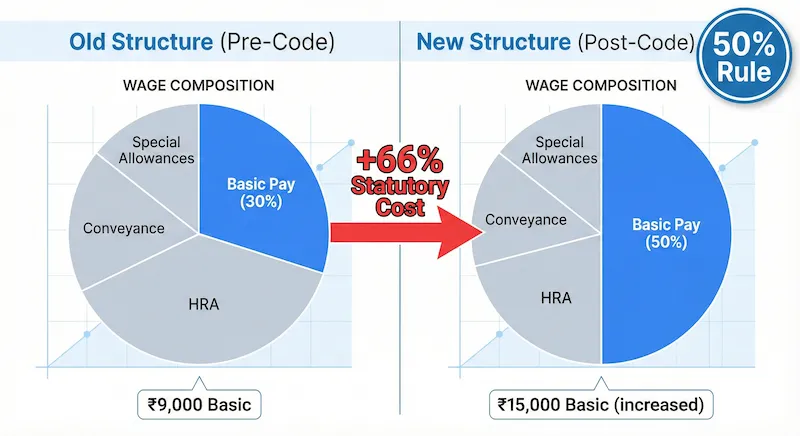
- The “50% Rule” mandates that basic pay be at least 50% of total CTC, reshaping salary structures across the industry.
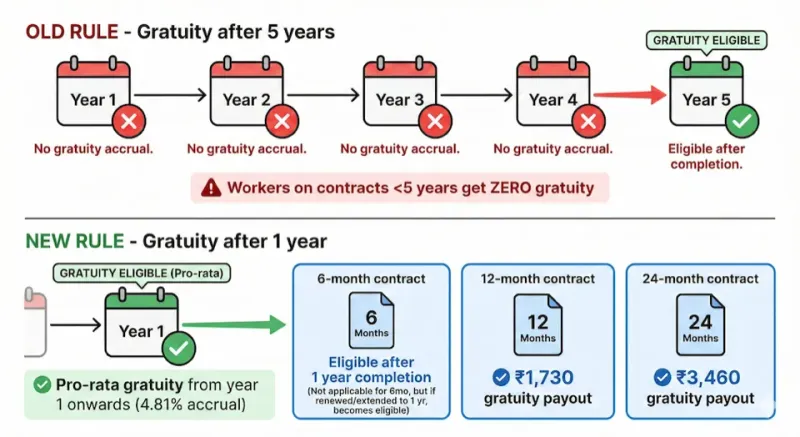
- Fixed-Term Employment (FTE) is now legally recognized with pro-rata gratuity eligibility from year 1 (previously 5 years).
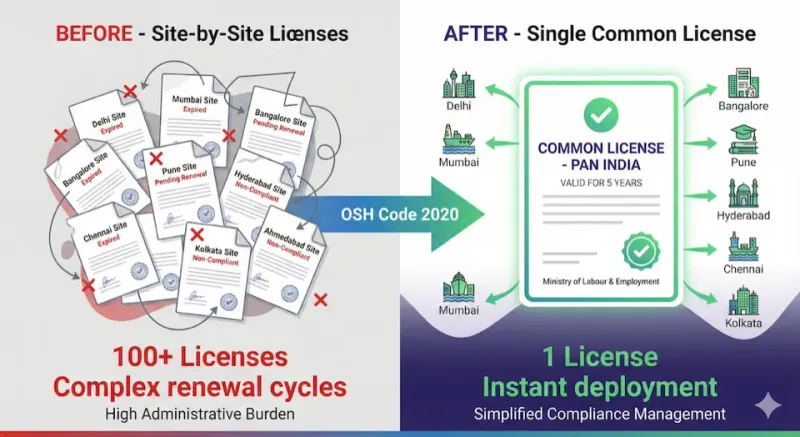
- A single “Common License” replaces 100+ site-specific licenses — a major operational simplification for multi-state contractors.
- Women are now legally permitted in night shifts across all establishments with safety and transport provisions.
- Implementation deadline: March 31, 2026 — companies must restructure salaries, digitize compliance, and renegotiate contracts.
Executive summary: the transformation ahead
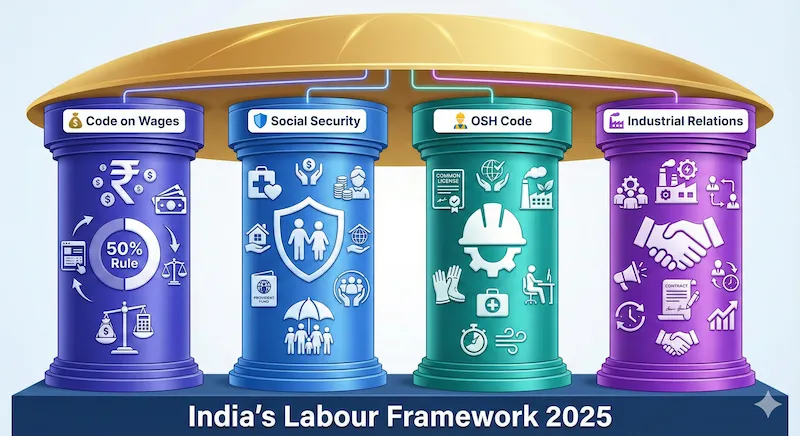
India’s labour law landscape is experiencing its most profound transformation since independence. The consolidation of 29 fragmented laws into 4 unified codes — Code on Wages (2019), Code on Social Security (2020), Occupational Safety, Health & Working Conditions Code (2020), and Industrial Relations Code (2020) — represents a paradigm shift from colonial-era regulations to a modern, digitized framework.
For the Facility Management and Security Services sectors, this transition is both seismic and existential. These industries, which employ millions and operate on thin margins, face immediate financial impacts, operational complexities, and strategic opportunities. Wage restructuring alone will increase employer statutory costs by 60-66%. Yet for organized players like Knighthood that adapt proactively, the shift promises massive competitive advantages through streamlined compliance, talent inclusion, and transparent digital processes.
“The new codes eliminate the ‘Inspector Raj’ that plagued Indian industry for decades. What replaces it is algorithmic, transparent, digital compliance. For companies prepared to embrace this shift, it’s a once-in-a-generation competitive advantage.”
The financial reality: a ₹30,000 supervisor case study
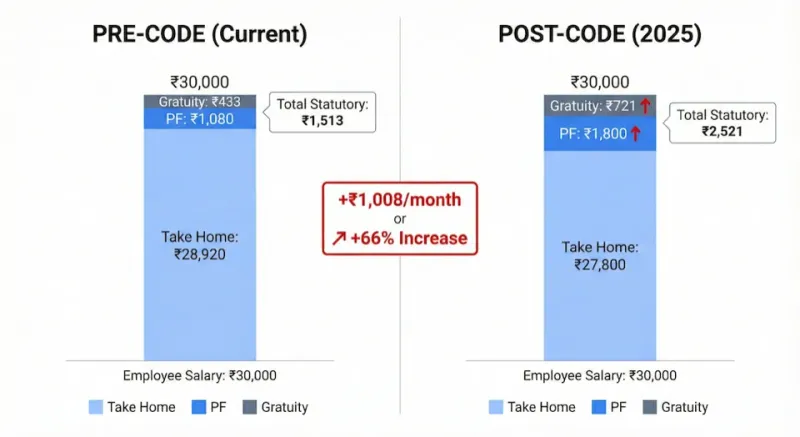
To understand the immediate impact, consider a typical security supervisor earning ₹30,000 per month under the current (pre-Code) salary structure:
| Component | Pre-Code (old) | Post-Code (compliant) | Change |
|---|---|---|---|
| Basic + DA | ₹9,000 (30%) | ₹15,000 (50%) | +₹6,000 |
| HRA + Conveyance + Special | ₹21,000 | ₹15,000 | -₹6,000 |
| PF Contribution (12%) | ₹1,080 | ₹1,800 | +₹720 |
| Gratuity Accrual (4.81%) | ₹433 | ₹721 | +₹288 |
| Total statutory cost | ₹1,513/month | ₹2,521/month | +₹1,008 (+66%) |
Implication: For a facility management contract managing 100 supervisors, this translates to an unbudgeted annual cost increase of ₹12.1 lakhs. Without contract renegotiation or pricing restructuring, profit margins evaporate overnight.
The four codes: detailed breakdown
The 29 legacy laws have been consolidated into 4 comprehensive codes. Each code addresses specific dimensions of employment:
Code 1: The Code on Wages, 2019
Consolidates the Payment of Wages Act (1936), Minimum Wages Act (1948), Payment of Bonus Act (1965), and Equal Remuneration Act (1976).
Key provisions
- Unified “Wages” definition: All remuneration capable of expression in money, with specific exclusions (HRA, overtime, commission, gratuity, retrenchment).
- The 50% Rule (critical): If exclusions exceed 50% of total remuneration, the excess amount becomes “wages” for statutory purposes.
- National floor wage: Central Government fixes a national minimum; states cannot go below this floor.
- Strict payment timelines: Wages payable by 7th of following month; full & final settlement within 2 working days of exit.
- Variable Dearness Allowance (VDA): Revised every 6 months to counter inflation.
Impact on FM/security companies
- Financial: Wage restructuring increases PF/Gratuity liabilities by 60%+. Thin-margin contracts become unprofitable without renegotiation.
- Operational: 2-day F&F settlement requires digital asset tracking and re-engineered offboarding processes.
- Strategic: Shift to transparent “Bill of Materials” pricing where statutory costs are passed through as actuals, protecting margins.
Code 2: The Code on Social Security, 2020
Consolidates 9 social security laws including the Employees’ Provident Fund Act (1952), Employees’ State Insurance Act (1948), and Maternity Benefit Act (1961). Primary ambition: extend social security to the 90% of India’s workforce in the unorganized sector.
Key provisions
- Fixed-Term Employment (FTE): Now legally recognized with full clarity — employers can hire for specific durations without fear of permanent employment claims.
- Pro-rata gratuity for FTE: Workers completing 1 year of service (not 5) are eligible for gratuity: (Last Drawn Wages × 15/26) × Completed Years.
- Gig & platform workers: First-time legal recognition; aggregators must contribute 1-2% of turnover to social security fund (capped at 5% of worker payouts).
- Joint & several liability: Principal employers are liable for contractor defaults in social security contributions.
- Maternity benefits & creche: 26 weeks paid leave; establishments with 50+ employees must provide creche (or pool resources for common creche).
Impact on FM/security companies
- Opportunity: FTE legitimacy allows exact workforce-revenue matching. 6-month contracts are now fully legal and compliant.
- Risk: Gratuity accrual for FTEs adds 4.81% monthly cost. Must be budgeted into project pricing upfront.
- Liability: Joint liability for contractor defaults — vet contractors rigorously and include indemnity clauses in all contracts.
Code 3: Occupational Safety, Health & Working Conditions (OSH) Code, 2020
Consolidates 13 laws including the Factories Act (1948) and Contract Labour (Regulation and Abolition) Act (1970). Modernizes physical compliance landscape.
Key provisions
- Common License revolution: A single national license replaces site-by-site licenses. Valid for 5 years vs. annual renewals previously.
- Applicability threshold: Raised from 20 to 50 workers; smaller operations now exempt from detailed licensing.
- Women in night shifts: Now legally permitted in all establishments (previously restricted) subject to written consent, safety measures, and transportation.
- Inter-state migrant workers: Journey allowance mandatory (annual travel fare to native state).
- Safety committees & officers: Mandatory for large establishments (500+ workers in factories, 250+ in hazardous processes).

Impact on FM/security companies
- Major win: A single Common License massively reduces admin burden. Multi-state operations can now deploy instantly without waiting for site-specific license approvals.
- Inclusion opportunity: Female night guards are now legal. Expands hiring pool, reduces wage pressures, increases workforce diversity.
- Cost consideration: Migrant worker journey allowance (~₹500-800/year) is a new mandated benefit. Budget accordingly in labour-intensive regions.
Code 4: Industrial Relations Code, 2020
Consolidates the Industrial Disputes Act (1947), Trade Unions Act (1926), and Industrial Employment (Standing Orders) Act (1946). Addresses unions, strikes, retrenchment, and workforce management flexibility.
Key provisions
- 300-worker threshold for retrenchment: Increased from 100 — establishments with up to 300 workers can now rightsize without government permission (must pay statutory compensation only).
- Worker re-skilling fund: Employers must contribute 15 days of last-drawn wages per retrenched worker into a fund (separate from retrenchment compensation).
- Grievance Redressal Committees (GRCs): Mandatory for 20+ employee establishments; must resolve disputes within 30 days.
- Strike notice & lockout rules: Mandatory 14-day notice period before strikes; lockout restrictions on public utilities.
- Union recognition: 51% membership = sole negotiating agent; below 51%, a Negotiating Council is formed with multi-union representation.
Impact on FM/security companies
- Flexibility: Branches with <300 workers can rightsize without bureaucratic hurdles. Helps mid-sized operations adapt to contract cancellations.
- Cost: Re-skilling fund adds ₹1,125 per retrenched employee (15 days @ ₹75/day average). Budget for attrition in annual planning.
- Governance: GRCs required. Standardize grievance procedures — reduces labour disputes and improves workplace harmony.
Implementation roadmap for FM/security companies
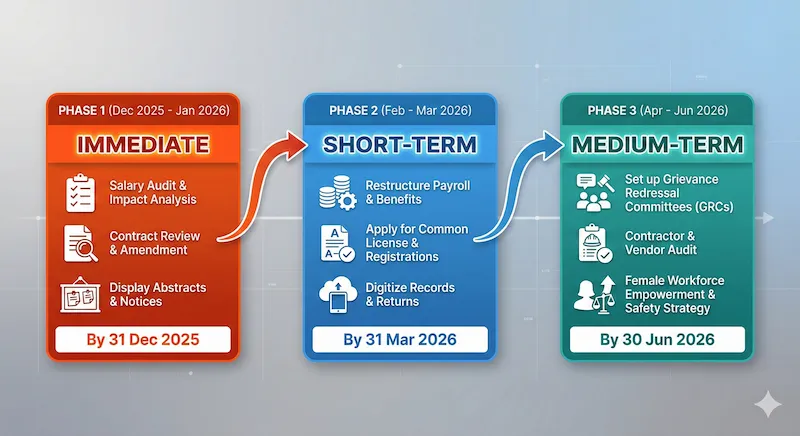
Phase 1: Immediate (December 2025 - January 2026)
- Audit salary structures: Check if Basic Pay is ≥50% of CTC. If <50%, flag for urgent restructuring.
- Review employment contracts: Update all offer letters with new wage definitions, FTE clarity, and 2-day F&F language.
- Display labour code abstracts: Post mandatory abstracts at all workplace locations.
- Monitor state notifications: Gazette notifications for your state’s implementation rules are being issued — track daily.
Phase 2: Short-term (February - March 2026)
- Restructure payroll: Implement new compliant salary structure. Most critical — this is your wage baseline going forward.
- Apply for Common License: Submit OSH Code common license application. Massively simplifies multi-state operations.
- Digitize compliance: Shift from manual registers to digital dashboards. Required for Shram Suvidha portal integration.
- Renegotiate client contracts: Include statutory cost escalation clauses. Pass-through wage increases to clients.
Phase 3: Medium-term (April - June 2026)
- Establish Grievance Redressal Committees: Required for 20+ employee establishments. Reduces labour court litigation.
- Vet all contractors: Joint & several liability means you’re liable for their defaults. Conduct compliance audits.
- Plan female workforce strategy: Women are now legal for night shifts. Plan deployment; budget transportation costs.
- HR & operations training: Train teams on new procedures, timelines, penalties, and compliance protocols.
Key dates & compliance milestones
| Date | Milestone | Action required |
|---|---|---|
| November 21, 2025 | Official notification of all 4 codes | Review codes; assess impact; communicate to HR |
| December 2025 - February 2026 | State rules being notified (staggered by state) | Monitor your state’s gazette for specific rules |
| January 15, 2026 | Recommended date to begin salary restructuring | Implement new payroll structure company-wide |
| February 1, 2026 | Apply for Common License (OSH Code) | Submit to labour authorities in your state |
| March 31, 2026 | End of FY 2025-26 | All restructuring complete; digital compliance live |
| Every 6 months thereafter | VDA (Dearness Allowance) revision | Monitor and implement wage increases |
Critical compliance checklist
Before March 31, 2026: non-negotiable actions
- ☐ Salary audit complete; Basic Pay ≥50% of CTC confirmed
- ☐ Employment contracts updated with new wage definitions and FTE language
- ☐ Client contracts renegotiated with statutory cost escalation clauses
- ☐ Common License application submitted (OSH Code)
- ☐ Payroll system restructured; new salary components live
- ☐ Manual registers replaced with digital compliance dashboard
- ☐ GRC (Grievance Redressal Committee) established for 20+ employee units
- ☐ Female employee night shift consents obtained (if applicable)
- ☐ All contractors vetted for compliance; indemnity clauses signed
- ☐ Labour Code abstracts displayed at all locations
- ☐ HR & Operations team trained on new procedures and penalties
The opportunity: from burden to competitive advantage
While the immediate financial impact is real and substantial, the strategic opportunity is far greater. The new Labour Codes eliminate decades of regulatory fragmentation and “Inspector Raj” corruption. In their place comes algorithmic, transparent, digital compliance.
For organized FM and security companies like Knighthood, this is transformative:
- Compliance simplification: One set of rules, one digital portal (Shram Suvidha), one license. Unorganized competitors without digital infrastructure will struggle.
- Talent inclusion: Women in night shifts, gig workers with benefits, FTE legitimacy — expands hiring pool and improves retention.
- Margin recovery: Transparent “Bill of Materials” pricing with statutory cost pass-throughs protects margins better than old fixed-fee models.
- Client relationship shift: From “compliance risk” (unorganized competitors) to “compliance assurance” (organized players). Principal employers now face joint liability — they’ll demand certified contractors.
The next 6 months are pivotal. Companies that move early and adapt comprehensively will emerge as category winners. Those that delay or half-implement will face margin compression, compliance penalties, and market loss.
Using the Labour Codes pricing calculator
Understanding theoretical impacts is important. Generating real, accurate pricing quotes for your specific state, wage class, and contract terms is critical. Knighthood’s Labour Codes Pricing Calculator is purpose-built to bridge this gap — generate real-time, compliant labour cost quotes based on your state’s actual minimum wages, job classifications, and contract parameters, and download PDF proposals for clients instantly. Launch the calculator.
Conclusion: the path forward
India’s 2025 Labour Codes represent the country’s most significant labour law reform in decades. For facility management and security services — industries that employ millions and operate on thin margins — this transition is simultaneously a challenge and an opportunity.
The challenge is immediate and quantifiable: wage restructuring alone increases statutory costs by 60-66%. Operational changes (2-day F&F settlement, digital compliance, common licensing) require process re-engineering. State-by-state rule notifications create compliance complexity during the transition period.
But the opportunity is far greater: organized companies that adapt comprehensively will win market share from unorganized competitors who cannot manage the digital complexity. The old “Inspector Raj” is gone, replaced by transparent algorithmic compliance. For companies prepared for this shift, it’s a once-in-a-generation competitive advantage.
The next 6 months are pivotal. Begin your salary audit today. Update your contracts now. Apply for the Common License immediately. Digitize your compliance infrastructure. The companies that move decisively will not just survive this transition — they will thrive in India’s modernized labour landscape.
“The intent of the government is clear: compliance should not be a burden but a hygiene factor. By ensuring workers are well-paid and socially secure, and employers are freed from archaic restrictions, the Codes aim to build a robust industrial ecosystem. For Knighthood and organized players, this is not a hurdle — it’s a catalyst for industry professionalization.”
This report is for informational purposes only. Figures and timelines are based on government notifications as of December 2025. Consult legal and tax professionals for your specific situation.
Send the requirement
If this resource points at a decision you are close to making, send us the scope — sites, roles and shifts — and we will confirm the licence, supervision and commercial position for your situation.
Discuss your requirement