
Gig economy vs traditional staffing: the hidden costs
What the gig economy offers, and the two costs that gig models hide — the capacity buffer you need to keep posts filled, and the algorithm fatigue that drives workers back to traditional employment.
By Knighthood Team
Published 9 September 2025
Updated 24 August 2026
The gig economy is a free-market model in which freelancers, independent contractors, project-based workers and temporary hires take on work without being on a company’s payroll. Platforms connect workers and customers directly, letting companies scale without fixed headcount. On paper that looks like the flexible alternative to managed staffing. In practice, two costs hide below the surface of a gig model — the capacity buffer you need to keep posts filled, and the churn that platforms create through their own algorithms.
This guide covers what the gig economy is, the two hidden costs we see in real deployments, and what that means for a staffing decision.
Who is in the gig economy
Three participants make up the model:
- Independent workers — labour providers (drivers, delivery personnel, handymen) and service providers (designers, technicians, artisans) who take temporary engagements rather than employment.
- Platform companies — businesses that link workers and customers (ride-hailing, food delivery, e-commerce logistics) and take a cut of every service. They set the rules, the surge pricing and the order allocation.
- Consumers — the individuals or businesses buying the service.
The hidden cost: the capacity buffer
The promise of “pay only when you need them” obscures a mathematical reality: in a gig model you cannot hire ten people to do ten people’s work. Availability is unpredictable — workers chase incentives, take other platform work, and drop shifts. To hold ten productive positions, a gig operation typically has to onboard and manage 13–15 active workers, a 30–40% buffer over the requirement.
Compare that with a traditional employed team: ten positions need ten workers plus a small backup, because employed staff have a schedule obligation. The gig buffer is not optional — without it, coverage falls below requirement on a normal day. That buffer is a real cost: onboarding, training, management and turnover for workers you do not keep.
The hidden cost: algorithm fatigue
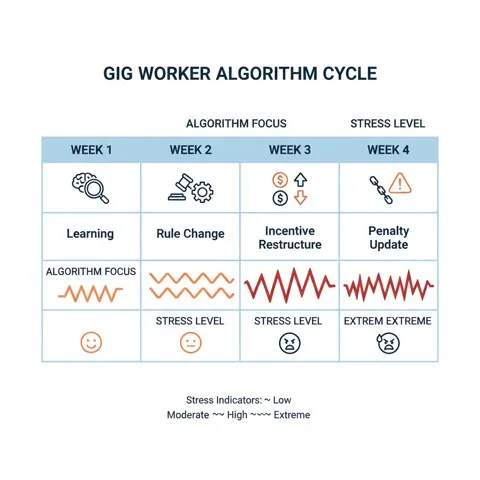
The second cost is what the platform’s constant rule changes do to the workforce. Platforms change their operational logic every week. Across interviews with workers returning to managed employment, the pattern repeats:
- Learning the rules — workers identify peak hours, profitable zones and the order targets that trigger bonuses.
- The algorithm shift — updates reallocate orders; previously profitable zones dry up and earnings drop.
- Incentive restructure — thresholds move, so the same effort earns less.
- Acceptance penalties — new rules penalise rejected orders, forcing workers to take unprofitable long-distance jobs.
The mental load is real. Workers spend their energy navigating the system instead of doing the work, rule changes happen faster than anyone can master them, and expertise stops being rewarded. Workers describe it as learned helplessness — and it drives experienced people back to predictable, managed employment where a shift and a wage are stable.
What this means for your staffing decision
Gig models suit spikes and low-skill, low-stakes volume where availability risk is acceptable. They suit poorly anything where coverage matters — a post that must be staffed, a shift that must run, a customer promise that must hold.
For those roles, the honest comparison is not “platform rate vs wage”. It is:
- the platform rate plus the 30–40% capacity buffer, re-hiring and supervision
- versus the managed workforce cost, which includes the statutory build-up but not a buffer
When you do that comparison, managed staffing is often the cheaper and more reliable way to hold a committed roster. See staffing services for how a managed workforce is delivered, and employment compliance in India for what the statutory side involves.
The bottom line
The gig economy is a useful tool, not a universal replacement. Its two hidden costs — the capacity buffer and the algorithm-driven churn — show up in the first quarter of operations. Do the math with the buffer in it before you commit a critical operation to a gig model.
Send the requirement
If this post points at a decision you are close to making, send us the scope — sites, roles and shifts — and we will confirm the licence, supervision and commercial position for your situation.
Discuss your requirement