
Logistics security: why insider risk is the biggest threat
The biggest security risk in logistics is already inside the facility — staff, drivers and contract workers with legitimate access. How to understand insider risk, the real cost of it, and what to require from a security partner.
By Knighthood Team
Published 23 June 2025
Updated 24 August 2026
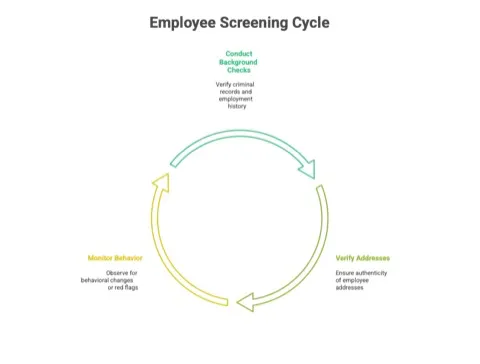
Companies invest heavily in perimeter walls, locks and alarms to keep threats out. In logistics, the most dangerous threats are already inside — wearing uniforms and carrying access cards. Employees, contractual staff, drivers and other personnel with legitimate access to facilities or goods account for a large share of theft and loss, and they have advantages an outsider does not: they are supposed to be there, they know the shift patterns and blind spots, and colleagues trust them.
This guide explains why the risk is amplified in logistics today, what a security incident actually costs, and what to require from a security or staffing partner so your operation is not the soft target.
Why logistics makes the risk worse
Three features of the sector work against security:
- Hiring under pressure. Warehouses and fulfilment centres scale fast, and positions are filled quickly. When a background check that should take weeks is compressed into days, screening gets skipped or rushed.
- High turnover. Constant recruitment pressure means new people arrive faster than the security culture can absorb them. Institutional knowledge of protocols leaves with the experienced workers.
- Inconsistent verification. Different standards across a supply chain — some sites screening thoroughly, others not at all — leave gaps that are easy to walk through.
The result is a perfect storm: a large, fast-changing workforce, verified unevenly, moving high-value goods.
What an incident actually costs
The visible cost is the stolen goods. The real cost is everything around it:
- Direct losses — stolen merchandise, damaged goods, and contamination (critical in cold chain and pharma).
- Operational disruption — investigation downtime, system overhauls mid-operation, and replacing staff.
- Insurance and clients — a poor security record raises premiums, and major customers require security guarantees.
- Reputation and compliance — incidents draw regulatory scrutiny and spread fast in industry networks.
Because the losses compound, the cheapest insurance is a workforce and a process that reduces the chance of the incident happening at all.
Screening and verification: the first line of defence
The single highest-value control is verifying people before they start:
- Identity and document checks — proof of identity, address and education, checked, not collected
- Police/court and employment verification — prior employment confirmed with actual employers, gaps explained
- Reference checks — a reference that is actually contactable and answers
- Financial-stress awareness — for roles with high-value access, an honest assessment of pressure points
Rushed “streamlined” screening is exactly how a bad hire slips through. Insist on a partner whose screening is documented and audit-proof — see the due-diligence guide for the questions to ask.
Segment-specific security: one approach does not fit all
A generic security approach fails at both ends — either over-engineered (costly, intrusive, staff-resistant) or under-engineered (missed in exactly the segments where it matters). Different logistics segments need different controls:
- E-commerce fulfilment — high-velocity, seasonal surge (staff can multiply several-fold), many touchpoints. Needs scalable access control, zone-based storage (biometrics on high-value racks), real-time inventory tracking, and secure dispatch with carrier verification.
- Cold chain and pharma — temperature excursions are the security incident, not just theft. Needs integrated alarms that lock down zones, alert response, backup protocols, and an audit trail for regulatory compliance.
- Grade-A and 3PL warehousing — multiple clients, multiple standards. Needs client-partitioned access, clear security for loading/unloading, and reporting that each client can trust.
- Manufacturing-linked storage — just-in-time pressure and specialized materials. Needs security that does not slow the line while protecting the stock.
The right conversation with a vendor is “what controls does MY segment need”, not “how many guards do you have”.
What to require from a partner
Before you engage a security or staffing partner for a logistics site, require:
- Verified, not just recruited — the partner proves identity, employment and reference checks per hire.
- Licensed and compliant — a valid PSARA licence for the state and clean labour compliance (wages, PF, ESI), so the agency is genuinely the employer.
- Access control and monitoring — a real access system with zones, and monitoring plus reporting you can see (attendance, exceptions, incidents).
- Supervision and reporting — a named supervisor accountable for the site and a report you can act on.
- Segment experience — evidence they have secured your type of operation, not just any site.
For the full picture of what a compliant build-up and supervision layer costs, see what a security guard costs, how to choose a security agency, and the logistics and warehousing industry page.
The bottom line
Logistics security is a people problem before it is a technology problem. The guard, the driver and the packer you have not properly verified are the risk. Screen and verify, secure by segment, monitor with supervision, and report to leadership — then the technology you deploy has a chance to work.
If you are securing or staffing a warehouse now, send us the sites, the products and the segments, and we will confirm the licence, verification and supervision position for your operation.
Send the requirement
If this post points at a decision you are close to making, send us the scope — sites, roles and shifts — and we will confirm the licence, supervision and commercial position for your situation.
Discuss your requirement