
CLRA explained: licensing, registration and contract staffing
CLRA stands for the Contract Labour (Regulation and Abolition) Act, 1970, which regulated contract labour for more than fifty years until it was repealed on 21 November 2025. This guide explains how its registration and licensing worked, and what replaced them.
By Knighthood Team
Published 15 October 2026
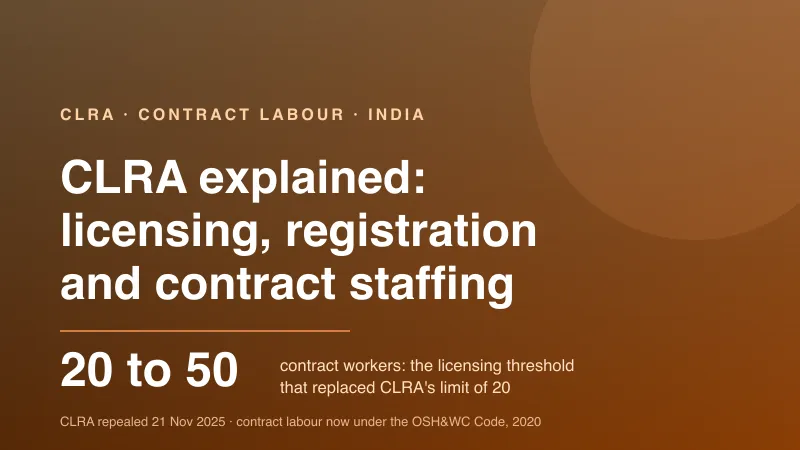
CLRA stands for the Contract Labour (Regulation and Abolition) Act, 1970, the law that regulated contract labour in India for more than fifty years. It did three things: it made the establishment register, it made the contractor take a licence, and it placed the principal employer behind both. CLRA was repealed on 21 November 2025, when the four labour codes came into force and contract labour moved into the Occupational Safety, Health and Working Conditions (OSH&WC) Code, 2020.
The acronym is still the term buyers, vendors and inspectors use. This guide sets out what CLRA required, how registration and licensing worked under it, what it meant for contract staffing, and what those obligations look like under the Code that replaced it. It sits under our contract labour compliance guide, which covers the current regime in full.
Key takeaways
- CLRA is the Contract Labour (Regulation and Abolition) Act, 1970, Act No. 37 of 1970 (India Code, retrieved 17 October 2026). It applied at 20 or more contract workers.
- Registration was the principal employer’s duty and produced a certificate of registration. Licensing was the contractor’s duty and produced a licence naming a maximum headcount.
- A CLRA licence ran 12 months, was non-transferable, and had to be displayed at the work site. Deploying more workers than the licence allowed was itself a contravention.
- CLRA was repealed on 21 November 2025. Under the OSH&WC Code the threshold is 50 workers, a licence runs five years, and one licence can cover more than one state or the whole country.
- The wage fallback, the welfare duty and the penalty scale all moved toward the principal employer. The licence is a procurement document, not a vendor’s back-office item.
What CLRA means, and what it covered
CLRA is the short name for the Contract Labour (Regulation and Abolition) Act, 1970. Parliament passed it as Act No. 37 of 1970, and it came into force on 10 February 1971. Its purpose was not to end contract labour but to regulate it: to set who could supply it, who had to register, who paid the workers, and when the appropriate government could prohibit it altogether.
The Act applied to an establishment where twenty or more workmen were employed as contract labour on any day in the preceding twelve months, and to every contractor who employed twenty or more workmen. It did not apply where only work of an intermittent or casual nature was performed. The law put a number on that exclusion: work was not intermittent if it ran for more than 120 days in the preceding twelve months, or more than 60 days for seasonal work.
Three definitions carried the whole scheme:
- Contract labour was a workman hired in or in connection with the work of an establishment by or through a contractor, with or without the knowledge of the principal employer.
- A contractor was a person who undertook to produce a given result for the establishment through contract labour, or who supplied contract labour for any work of the establishment. Sub-contractors were included.
- The principal employer was the factory owner or occupier, the mine owner or manager, or, in any other establishment, the person responsible for its supervision and control.
State law had already diverged before the repeal. Eight states had raised the CLRA threshold from 20 to 50: Maharashtra, Andhra Pradesh, Uttar Pradesh, Rajasthan, Gujarat, Arunachal Pradesh, Haryana and Bihar. Jammu and Kashmir and Ladakh set it at 40 (India Code, state amendments). That patchwork is part of why the 2020 Code substituted a single national threshold.
Registration under CLRA: the principal employer’s certificate
Registration was the buyer’s obligation, not the vendor’s. Section 7 required every principal employer of a covered establishment to apply to the registering officer in the prescribed manner. Under the Contract Labour (Regulation and Abolition) Central Rules, 1971, the application was made in triplicate in Form I to the registering officer for the area, with the prescribed fee. If the application was complete, the officer registered the establishment and issued a certificate of registration in Form II.
The certificate was not a formality. It recorded the nature of the work carried on, the names and addresses of the contractors, the nature of the work given to contract labour, and the maximum number of contract labour to be employed on any day through each contractor. A change in those particulars had to be intimated to the registering officer within 30 days.
Two consequences followed, and both are worth remembering because they still shape licence checks today:
- Registration attached to the establishment, not to a contract. It did not lapse when a contractor changed. The establishment stayed registered even as its vendors came and went.
- No registration meant no contract labour. Section 9 barred a principal employer whose establishment was unregistered, or whose registration had been revoked, from employing contract labour at all. Revocation under section 8 was available where registration had been obtained by misrepresentation, suppression, or had become useless or ineffective.
Registration was the buyer’s half of the chain. The licence was the contractor’s.
Licensing under CLRA: the contractor’s licence
Section 12 was the licensing spine: no contractor to whom the Act applied could undertake or execute any work through contract labour except under a licence issued by the licensing officer. The application process linked the two sides of the engagement together.
- The contractor applied in triplicate in Form IV to the licensing officer for the area.
- The application had to carry a certificate from the principal employer in Form V, confirming the contractor had been engaged and that the employer undertook to be bound by the Act.
- The applicant deposited the prescribed security and paid the licence fee, both banded by the number of workers.
- If the officer was satisfied, the licence issued in Form VI.
The licence was specific about what it permitted. By rule and condition it was non-transferable, it named the maximum number of workmen who could be employed, and it bound the contractor to pay not less than the applicable minimum wage. A copy had to be displayed prominently at the premises where the contract work was carried on, and the contractor had to notify the licensing officer of any change in the number of workmen or the conditions of work.
Rule 27 of the CLRA Central Rules, 1971 gave every licence a validity of twelve months, renewable under Rule 29. Renewal had to be applied for not less than 30 days before expiry, and a late application attracted a 25% excess fee unless the delay was unavoidable.
Before granting or refusing a licence, the officer weighed the matters set out in Rule 22: whether the applicant was a minor, of unsound mind or an undischarged insolvent, or had been convicted in the previous five years of an offence involving moral turpitude; whether an order existed prohibiting contract labour in that type of work; whether a licence had been revoked or suspended within the previous three years; and whether the fees and security had been deposited. An aggrieved applicant could appeal under section 15 within 30 days.
A licence was not the only paper the contractor owed. Under the Central Rules the licensee had to intimate the commencement and completion of each contract work to the Inspector, and the principal employer had to do the same under its own return. The point of the licensing chapter was not the certificate on the wall. It was the headcount, the work site and the wage floor written into it.
What CLRA meant for contract staffing
CLRA drew a bright line between the contractor as employer of record and the principal employer as the establishment that hosted the work. The contractor hired, supervised and paid the workers. The principal employer registered, hosted and stood behind the wage and welfare duties. That split is the template most staffing contracts still use. For the buyer’s version of that decision — when contract staffing is the right model and when to hire permanently — see contract staffing vs permanent hiring.
Section 21 covered wages. The contractor was responsible for paying wages by the prescribed period, which the Central Rules fixed at the seventh day after the end of the wage period where fewer than 1,000 workers were employed, and the tenth day otherwise. The principal employer had to nominate an authorised representative to be present at disbursement and to certify the amounts paid. If the contractor failed to pay or underpaid, the principal employer became liable for the full wage or the shortfall, and could recover it from the contractor by deduction or as a debt. The Calcutta High Court applied exactly that provision against a principal employer in 2021 (Kartick Chandra Mahish v. Union of India).
Welfare sat with the contractor first. Sections 16 to 19 required the contractor to provide canteens where 100 or more contract workers were ordinarily employed, rest rooms where workers halted at night, drinking water, latrines, washing facilities and first-aid boxes. Section 20 made the principal employer liable to provide any amenity the contractor failed to provide, and to recover the cost. This is the part of CLRA that inspections checked most often, because it is visible from the gate.
Records and returns followed the same division. The principal employer kept a register of contractors; the contractor kept a register of persons employed, issued employment cards and service certificates, and maintained the muster roll, wage register, deduction, fines, advances and overtime registers. Records were preserved in original for three calendar years from the last entry. The contractor filed a half-yearly return to the licensing officer; the principal employer filed an annual return to the registering officer.
Section 10 held the abolition power. The appropriate government could prohibit contract labour in any process, operation or other work after consulting the Central or State Advisory Board, weighing whether the work was incidental to the industry, perennial in nature, ordinarily done by regular workmen, and sufficient to employ a considerable number of whole-time workers. Prohibition was a notification, not a general ban: the Act regulated first and abolished in specific cases.
Non-compliance carried criminal exposure. Under sections 23 and 24 a contravention of the provisions regulating contract labour, or of a licence condition, was punishable with imprisonment up to three months or a fine up to ₹1,000, with a further ₹100 for every day the contravention continued after conviction.
Where CLRA stands now: repealed into the OSH&WC Code
CLRA no longer exists as a separate statute. It was repealed when the four labour codes were brought into force on 21 November 2025, and contract labour is now Part I of Chapter XI of the OSH&WC Code, 2020 (PIB, India’s Labour Reforms, 21 November 2025). The OSH&WC Code also repealed twelve other laws, including the Inter-State Migrant Workmen Act, 1979 (OSH&WC Code, s.143).
The savings clause matters for anyone still holding CLRA paper. Anything done under the repealed Act, including rules, notifications and licences, “shall be deemed to have been done or taken under the corresponding provisions of this Code” and remains in force to the extent it is not contrary to the Code, until it is replaced (s.143(3)). A licence obtained under a repealed labour law, including a CLRA licence, is deemed to have been obtained under the Code, stays valid for the period it was issued for, and must be obtained afresh after it expires (s.119(5)). A CLRA licence not yet expired did not vanish on 21 November 2025; it had to be renewed in the new system once its term ran out.
Four changes are worth carrying into any current contract review:
- The threshold moved from 20 to 50. Part I of the contract labour chapter now applies to establishments and manpower supply contractors with 50 or more contract labour (s.45), while safety, health and welfare standards apply across establishments at ten or more workers, and registration applies from ten (s.3).
- One licence, five years, all-India. A licence is valid for five years (s.48(3)), and a contractor can obtain a common licence for more than one state or the whole of India through the central designated authority, which consults the states electronically (s.47 proviso; s.119). A work-specific licence is available where the contractor does not meet the prescribed qualifications (s.47(2)).
- Deemed issue. A common licence is issued electronically within 45 days of application, and is deemed issued if the authority does not act (s.119(4)).
- The principal employer’s position is heavier. Welfare facilities under sections 23 and 24 must be provided by the principal employer (s.53); employing contract labour through a contractor who should hold a licence but does not is itself a contravention (s.54); and the wage fallback now runs alongside bank-transfer payment, principal-employer notification, and recovery from the contractor’s security deposit (s.55).
The Ministry’s own comparison of the old and new regimes confirms the intent: the contract labour threshold rose “from 20 to 50 workers as a result the contractor employing less than 50 contract labour will not require license,” alongside a single all-India licence valid five years (PIB OSH Code factsheet, 22 November 2025). The Ministry has also said the higher threshold was “for administrative ease” and does not reduce workers’ entitlements (Ministry of Labour and Employment FAQ, January 2026). Our labour codes guide covers the wider transition, and the labour codes reference sets out the statutory framework.
CLRA licence vs OSH&WC licence: what changed
| Point | CLRA (1970–2025) | OSH&WC Code (2025 onwards) |
|---|---|---|
| Applicability threshold | 20 or more contract workers (s.1(4)) | 50 or more contract workers (s.45) |
| Registration | Principal employer registers the establishment, Form I application, Form II certificate | Single electronic registration, threshold 10 workers (s.3) |
| Licence validity | 12 months (Rule 27) | 5 years (s.48(3)) |
| Geographic scope | One licence for the work and state named in it | One common licence, multi-state or all-India (s.47 proviso; s.119) |
| Issue and timing | Manual application, officer discretion | Electronic; deemed issued within 45 days if no action (s.119(4)) |
| Licence types | Standard licence | Standard plus work-specific licence (s.47(2)) |
| Wage responsibility | Contractor pays; principal employer liable on failure (s.21) | Contractor pays by bank transfer; principal employer fallback, recovery from security deposit (s.55) |
| Welfare facilities | Contractor provides; principal employer on default (ss.16–20) | Principal employer provides (s.53) |
| Non-licensed contractor | Contravention of the Act | Employing their workers is itself a contravention (s.54) |
| General penalty | Up to 3 months’ imprisonment or ₹1,000, plus ₹100/day (s.23) | ₹2 lakh to ₹3 lakh, plus ₹2,000/day (s.94) |
What to check now, whether you buy or supply contract labour
The licensing chapter has changed, but the questions a buyer should ask have not. Treat the following as procurement documents, not assurances.
- The licence. Current, in the right state, naming the right establishment and a worker count at or above your deployment. A national licence is one document; a state licence deployed in another state is a compliance failure.
- The work-order intimation. The contractor must intimate each work order to the designated authority; failure can lead to suspension or cancellation (s.50).
- The wage sheet. The rate per worker split into basic, dearness allowance and other components, checked against the notified minimum wage for that state, employment, skill level and zone.
- The 50% basic test. Basic wages at or above half of total remuneration, so the statutory base for provident fund, gratuity and bonus is not understated.
- Proof of payment. Bank-transfer evidence and the statutory contributions for the last two months, with establishment codes and challans. The PF and ESI compliance guide covers what those filings should show.
- The registers and returns. Who files what, on which date, and where the acknowledgements are stored.
- The contract terms. Audit rights over wage records and statutory challans, an automatic revision clause tied to the applicable wage notification, and the right to terminate for a lapsed licence.
For the wider vendor-risk picture, the contract labour compliance guide carries a ten-point due-diligence checklist, and our due diligence page covers the engagement-level review. If you supply contract labour rather than buy it, the same list is your licence file: the staffing service and payroll service pages set out how we run it.
Frequently asked questions
Is the CLRA Act still in force?
No. The Contract Labour (Regulation and Abolition) Act, 1970 was repealed on 21 November 2025, when the four labour codes came into force. Contract labour is now regulated by Part I of Chapter XI of the OSH&WC Code, 2020. Rules and notifications made under the repealed Act remain in force during the transition to the extent they are not contrary to the Code, until they are replaced.
What is the full form of CLRA?
CLRA is the Contract Labour (Regulation and Abolition) Act, 1970, Act No. 37 of 1970. It was enacted on 5 September 1970 and came into force on 10 February 1971, and it regulated the employment of contract labour in establishments and contractors above a headcount threshold.
Who needed a licence under CLRA, the contractor or the employer?
The contractor needed the licence; the principal employer registered the establishment. The two were linked: the contractor’s licence application had to carry a certificate from the principal employer, and a licence named the maximum number of workers and the work site. A principal employer that employed contract labour through an unlicensed contractor was exposed to the Act’s penalties.
How long was a CLRA licence valid?
Twelve months, under Rule 27 of the CLRA Central Rules, 1971. It was renewable under Rule 29, with the renewal application due at least 30 days before expiry. A late application attracted a 25% excess fee unless the delay was unavoidable. Under the OSH&WC Code that replaced it, a licence is valid for five years.
What replaced CLRA?
The OSH&WC Code, 2020 replaced CLRA, along with twelve other central labour laws. For contract labour the headline changes are the threshold (20 to 50 workers), the licence term (12 months to five years), the option of a single all-India common licence, and a larger set of obligations placed directly on the principal employer.
Does the 50-worker threshold mean I have no obligations below 50 contract workers?
No. The 50-worker threshold applies to the licensing chapter. Registration applies from ten workers, and health, safety and welfare standards apply to establishments with ten or more employees, including the contract labour on site. The principal employer’s duty to provide welfare facilities to contract labour follows that lower threshold, not the licensing one.
The bottom line
CLRA has been repealed, but the habits it forced on buyers are still the right ones. Registration made the establishment responsible; licensing put the headcount and the wage floor into a document a buyer could check; section 21 put the principal employer behind the contractor’s wage failure. The OSH&WC Code kept that architecture and raised the stakes: a 50-worker threshold, a five-year licence, a 45-day deemed-issue clock, and penalties in lakhs rather than hundreds. The licence and the wage sheet are still the two documents that decide whether the engagement is clean.
Our staffing service deploys contract manpower with attendance reconciled to a named roster and the licence, wage and welfare duties handled, and the payroll service runs the contributions and returns behind it. If you are re-papering contracts across several states, send us the sites, roles, shifts and current vendor terms, and we will set out what the applicable notifications and the Code require before the next renewal.
Send the requirement
If this post points at a decision you are close to making, send us the scope — sites, roles and shifts — and we will confirm the licence, supervision and commercial position for your situation.
Discuss your requirement