
Principal-employer liability for a non-compliant contractor
Your contractor is primarily liable for wages, PF and ESI. But when they default, the codes make you pay first and recover later. Here is where principal-employer liability starts, what it covers, and how to cap it in the contract.
By Knighthood Team
Published 16 October 2026
Updated 17 October 2026
The contractor employs the worker. That is where the law starts, and it is also where a lot of procurement teams stop reading. When the contractor fails — on wages, on provident fund, on the licence that allows them to supply labour at all — the liability does not stay with them. Under the labour codes in force since 21 November 2025, the principal employer pays first and recovers later.
This guide covers who the principal employer is, the obligations that survive a well-drafted contract, what happens when a contractor is unlicensed, what the failure actually costs, and where a contract can and cannot move the risk. It sits under our contract labour compliance guide, which covers the wider regime.
Key takeaways
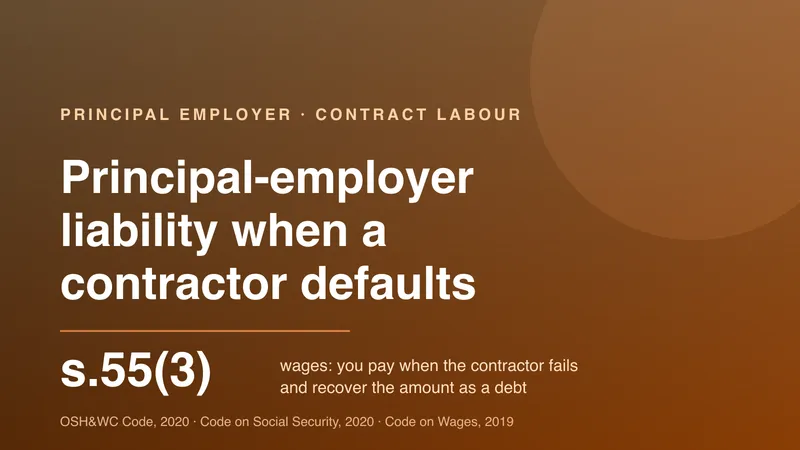
- The contractor is primarily liable for wages, but if they fail to pay within the prescribed period or underpay, the principal employer must pay the full amount or the shortfall and recover it from the contractor (OSH&WC Code, s.55(3)).
- Employing contract labour through a contractor who should hold a licence but does not is deemed a contravention of the Code itself — a penalty exposure for you, not just a dispute with the vendor (s.54).
- Provident fund and ESI contributions for contract workers follow the same shape. The employer pays both shares and recovers from the contractor by deduction or as a debt (Code on Social Security, 2020, s.31).
- You cannot contract out of these obligations. A clause that removes or reduces the liability is null and void (Code on Wages, 2019, s.60); an indemnity is a recovery right, not a shield.
- The general penalty under the OSH&WC Code is ₹2 lakh to ₹3 lakh, plus ₹2,000 for each day the contravention continues after conviction (s.94).
Who counts as the principal employer?
The principal employer is the organisation for whom the contract workers carry out the work, and it is defined by control rather than by contract. In a factory it is the owner, occupier or manager; in a mine, the owner or manager; in an office, the owner or manager; in a government establishment, the head of the department or a notified officer. Our principal employer reference sets out the full definition and the facilities that attach to it.
The label matters because the duties attach to the establishment, not to a purchase order. Changing the contractor does not change who the principal employer is. Neither does pushing the employment relationship onto the vendor’s letterhead. The Code on Wages makes the point in its fallback rule: where an employer fails to pay an amount due under the Code, the proprietor of the establishment in which the worker is employed is responsible for it (Code on Wages, 2019, s.43).
So the first question in any contract-labour arrangement is not “who is the employer?” — the contractor is — but “which obligations come back to the establishment when the employer fails?”
Where your wage liability begins
The contractor pays wages first. Section 55(1) of the OSH&WC Code makes the contractor responsible for paying each contract worker, by bank transfer or electronic mode, within the period the appropriate government prescribes. The central rules set that at the seventh day after the end of the wage period (OSH&WC (Central) Rules, 2026, Rule 98). Section 55(3) then does the work that matters to a buyer:
In case the contractor fails to make payment of wages … within the prescribed period or makes short payment, then, the principal employer shall be liable to make payment of the wages in full or the unpaid balance due … and recover the amount so paid from the contractor either by deduction from any amount payable to the contractor under any contract or as a debt payable by the contractor (OSH&WC Code, s.55(3), retrieved 17 October 2026).
Three consequences for how you manage the contract
First, the obligation is a fallback, not a shared bill. You are not liable while the contractor performs. You become liable the moment they do not.
Second, recovery is real but secondary. You can deduct the amount from what you owe the contractor, or treat it as a debt. The appropriate government can also order payment out of the contractor’s security deposit held under the licence (s.55(4)). Those routes presuppose a contractor with money or a deposit still in place. A vendor who has stopped paying wages is often a vendor with neither.
Third, a short payment counts. If the contractor prices a guard below the notified minimum wage for the state, skill level and zone, the shortfall is your liability too. The minimum wages in India guide and the wage notification guide explain how the floor is built, and the minimum wage reference carries the current rates. The Code on Wages (Central) Rules, 2026 also require the principal employer to pay the contractor the full wage element of the contract, so a discounted wage bill does not discharge the worker’s claim.
When an unlicensed contractor becomes your contravention
A licence is the contractor’s obligation, but the consequence of a missing one lands on you. Section 54 of the OSH&WC Code provides that where a principal employer employs contract labour through a contractor who is required to hold a licence but does not, “such employment shall be deemed to be in contravention of the provision of this Code” (s.54, retrieved 17 October 2026).
That is a different kind of exposure from a wage claim. It is a contravention of the Code itself, committed by the employer or principal employer of the establishment, and the general penalty under section 94 applies to “the employer or the principal employer of the establishment, as the case may be”. It does not depend on whether workers were paid correctly. A lapsed licence, a licence issued for another state, or a licence naming fewer workers than you deploy is enough.
The Code also requires the contractor to intimate each work order to the designated authority, and failing to do so can lead to suspension or cancellation of the licence (s.50). That makes licence status a live procurement document, not a certificate collected at onboarding. Our CLRA explainer covers how licensing worked under the repealed Act and what replaced it, and the compliance and licences page covers the operating licences that sit outside the labour codes.
PF, ESI and bonus: the same pay-then-recover pattern
Social security contributions follow the wage rule. Under the Code on Social Security, 2020, the employer must pay both the employer’s and the employee’s contribution for every employee, “whether directly employed by him or by or through a contractor” (s.31(1)). Where the employer has paid contributions for someone employed through a contractor, it can recover the amount from the contractor by deduction from any sum payable under the contract or as a debt payable by the contractor (s.31(6)).
The pre-code baseline still shapes enforcement
The earlier statutes had the same architecture, and it is worth knowing because enforcement habits are built on it. Section 40 of the ESI Act required the principal employer to pay both contributions for every employee, directly employed or through an immediate employer, and section 41 gave the right to recover from the immediate employer (ESI Act, 1948, ss.40–41). The Provident Funds Scheme imposed the same principal-employer responsibility for contract staff, which is why courts have repeatedly held buyers liable for a vendor’s PF arrears.
Bonus is the third item in the set. Where the contractor fails to pay the statutory minimum bonus, the principal employer becomes liable once the failure is notified in writing and confirmed, under the Code on Wages (Central) Rules, 2026 (Rule 21). None of this is exotic; it is the ordinary shape of the law. The practical question is whether the contract gives you the records, the audit right and the money to exercise the recovery.
Welfare, records and grievance are yours to provide
The Code reversed the old default on welfare. Contract-labour welfare was previously the contractor’s duty, with the principal employer liable only on failure. Now the welfare facilities under sections 23 and 24 “shall be provided by the principal employer of the establishment to the contract labour who are employed in such establishment” (s.53, retrieved 17 October 2026).
In practice, that merges the headcount used for facility standards into one site-wide number that includes every contract worker on every shift. Canteen, crèche, rest rooms and the safety committee all key off thresholds that now count the contract workforce. Our contract labour compliance guide sets out those thresholds in full.
Two further duties sit with the establishment rather than the vendor. Registers covering work performed, hours, rest days, wages, leave, overtime and attendance must be maintained and returns filed electronically (s.33). And the principal employer must run a grievance redressal mechanism for contract labour, through a committee with contractor representation, disposing of grievances within 30 days (Rule 184). A committee with minutes and a clock is the kind of thing an inspection asks to see.
What the failure actually costs
The penalty architecture is where the Code signals how seriously it treats this. The general penalty under section 94 applies to the employer or principal employer and runs from ₹2 lakh to ₹3 lakh, with a further ₹2,000 for each day the contravention continues after conviction (OSH&WC Code, s.94, retrieved 17 October 2026).
| Contravention | Penalty | Source |
|---|---|---|
| General contravention of the Code, rules or standards | ₹2 lakh to ₹3 lakh; ₹2,000 per day continuing after conviction | OSH&WC Code, s.94 |
| Failure to maintain registers or file returns | ₹50,000 to ₹1 lakh | OSH&WC Code, s.96 |
| Contravention of provisions regulating employment, including contract labour | ₹50,000 to ₹1 lakh; on repeat conviction, imprisonment up to three months or fine up to ₹2 lakh, or both | OSH&WC Code, s.97 |
| Late payment of ESI contributions | Simple interest at 12% a year, recoverable as an arrear of land revenue | ESI Act, 1948, s.39(5) |
Two procedural features matter when something has already gone wrong. Before prosecuting, the Inspector-cum-Facilitator must give the employer 30 days to comply, and no proceedings follow if the employer does — but that window is unavailable after an accident or for a repeat of the same violation within three years (s.110). Certain offences can also be compounded, at 50% or 75% of the maximum (s.114).
The statutory penalty is rarely the largest number. A wage shortfall across a 200-person site is a recovery demand, a re-run of the payroll, and a contractor who may not be able to fund either. That is why the answer is contract design, not a first-week checklist.
Can you contract out of it?
No, and it is worth quoting the provision that says so. Under the Code on Wages, “any contract or agreement whereby an employee relinquishes the right to any amount or the right to bonus due to him under this Code shall be null and void in so far as it purports to remove or reduce the liability of any person to pay such amount under this Code” (s.60).
A well-drafted contract does not reduce the principal employer’s liability to the worker or the authority. What it can do is preserve a recovery right against the contractor and give you the information to use it. Those are different objectives, and conflating them is how buyers end up with an indemnity clause worth less than the paper it is printed on. For how the engagement itself should be structured, see the staffing and outsourcing guide and the employment contracts guide.
How to cap your exposure before you sign
Run this before the purchase order and again at renewal. Each item is a document or a clause, not an assurance.
- Verify the licence as a procurement document. Check that it is current, issued for the right state, naming a worker count at or above your deployment, and intimated for this work order. A lapsed licence should trigger the replacement provisions in the agreement.
- Keep your own registration current. Establishment registration and the particulars on it must reflect the site, management and ownership.
- Fund the wage element in full. Pay the contractor the amount that carries the notified minimum wage, and reconcile the wage sheet to the applicable notification at each revision.
- Take payment proof, not promises. Bank-transfer evidence and PF and ESI challans for the last two months, with establishment codes.
- Require the records you would need in a claim. Wage sheets split into basic, dearness allowance and other components; attendance reconciled to a named roster; the grievance log.
- Write the recovery mechanics into the contract. A wage-funded payment obligation, an automatic revision clause tied to the notification, audit rights over wage and contribution records, and a set-off right against amounts payable.
- Demand an indemnity for past non-compliance — and treat it as a recovery route, not a substitute for verification.
- Flow the same terms down to subcontractors. A subcontracted workforce that is invisible in your contract file is still on your site and still in your headcount.
- Set a termination trigger for a lapsed licence or a missed statutory payment. The fastest way to end the exposure is to change the vendor before the inspector does.
Our due diligence page covers the wider vendor-risk picture, and the statutory compliance checklist lists the returns behind it. For contributions specifically, the PF and ESI compliance guide sets out what is due and when.
Frequently asked questions
Who pays contract workers if the contractor does not?
The contractor is primarily responsible and must pay within the prescribed period, which the central rules set at the seventh day after the wage period ends. If the contractor fails to pay or underpays, the principal employer must pay the wages in full or the unpaid balance, and can recover the amount from the contractor by deduction or as a debt (OSH&WC Code, s.55(3)).
Is the principal employer liable for PF and ESI contributions of contract workers?
Yes, as the payer of first instance. The Code on Social Security requires the employer to pay both the employer’s and the employee’s contribution for every employee, whether directly employed or engaged through a contractor, and then gives the right to recover from the contractor by deduction or as a debt (s.31). The ESI Act’s principal-employer provisions worked the same way.
Does an indemnity clause protect us from liability?
It gives you a right to recover from the contractor, but it does not reduce your liability to the worker or to the authority. The Code on Wages makes any agreement that removes or reduces the liability to pay amounts due null and void (s.60). Treat the indemnity as a recovery mechanism that works only if the vendor can pay.
What happens if the contractor’s licence lapses during the contract?
Employing contract labour through a contractor who should hold a licence but does not is deemed a contravention of the Code itself (s.54), regardless of whether workers were paid correctly. Licence status is a live item on the contract file, and a lapse should trigger the termination and replacement provisions in the agreement.
Can we be penalised for a contractor’s failure even if we were not involved?
The general penalty under the OSH&WC Code applies to the employer or the principal employer of the establishment, and the deemed contravention in section 54 attaches to the employment, not to your knowledge of the vendor’s paperwork. Verification is the control, not good faith.
The bottom line
The contract-labour regime does not ask you to run the contractor’s payroll. It asks you to accept that the establishment is the backstop. Wages, PF, ESI, bonus and welfare now come back to the principal employer when the contractor fails, and a missing licence turns the relationship itself into a contravention. The defence is unglamorous and entirely within your control: verify the licence and the wage sheet as procurement documents, take payment and contribution proof every month, and put audit, set-off and termination rights in the contract.
Our staffing service deploys contract labour with attendance reconciled to a named roster and statutory handling on the vendor side, and the payroll service manages the contributions and returns behind it. If you are re-papering contracts across several sites, send us the roles, shifts and current vendor terms and we will set out where the liability sits before the next renewal.
Send the requirement
If this post points at a decision you are close to making, send us the scope — sites, roles and shifts — and we will confirm the licence, supervision and commercial position for your situation.
Discuss your requirement