
How to read a wage notification: basic, VDA and special allowance
A wage notification is not one number. It is a basic rate plus a variable, cost-of-living component that states label either VDA or a special allowance. This guide reads a real notification line by line and shows what each field commits you to.
By Knighthood Team
Published 6 October 2026
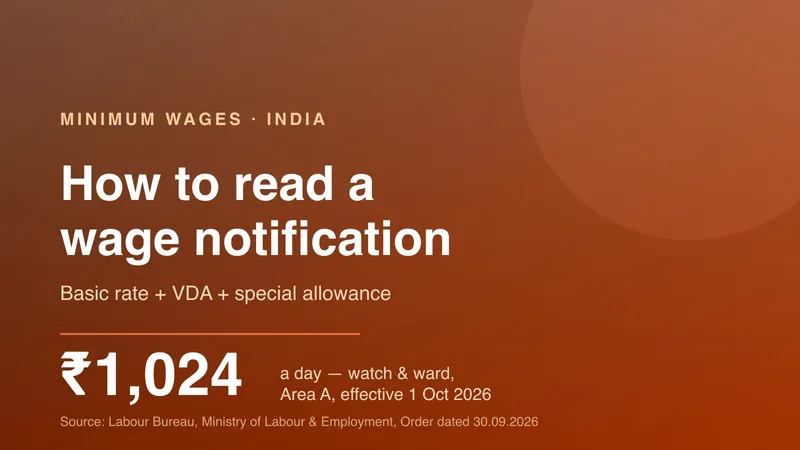
A wage notification is the government order that sets the lowest amount you may legally pay for a scheduled employment in a given state and area. It is not one number. It is a structure: a basic rate plus a variable, cost-of-living component that the central government calls the variable dearness allowance (VDA) and that Maharashtra and a few other states publish as a “special allowance”. Read the headline total without its row, or apply the wrong authority’s order, and you can underpay a worker while believing you are compliant. This guide reads a real notification line by line and shows what each field commits you to. It sits under the minimum wages in India pillar and pairs with how VDA works in minimum wages.
Key takeaways
- A notified minimum wage is a basic rate plus a variable component. The variable part is called VDA in the central sphere and most states, and a “special allowance” in a few, including Maharashtra. The mechanism is the same.
- Every rate is scoped to an employment, a skill category and an area or zone. One job title can carry three different lawful totals inside the same state.
- Notifications quote rates per day. Convert on the notified basis — usually 26 working days — before you budget a month.
- “Special allowance” in a notification is the statutory cost-of-living component. “Special allowance” in your own salary structure is a residual the Code on Wages treats as wages. Do not swap the meanings.
What a wage notification actually contains
Every minimum-wage order answers the same six questions, usually in the same order. Once you can find them, the document stops being dense.
- Who issued it, and under which law — the letterhead and the opening paragraph.
- Which scheduled employment it covers.
- Which skill category — unskilled, semi-skilled or skilled.
- Which area, zone or class of city the rate belongs to.
- The basic rate, and the variable component added to it.
- The effective date, and the period the revision covers.
The Code on Wages, 2019 lets a government build a minimum rate in more than one way: a basic rate plus a cost-of-living allowance, or a basic rate with or without that allowance plus the cash value of concessions, or a single all-inclusive rate (Code on Wages, 2019, section 7, “Components of minimum wages”). In practice the first form is the common one, and it is why a notification has two or three columns rather than one.
Step 1: Read the letterhead and the law it cites
The issuing authority is the first thing to check, because it decides whether the order applies to you at all.
Central sphere. Orders from the Labour Bureau or the Chief Labour Commissioner (Central) cover establishments under the central government, railways, mines, oilfields, major ports and central public-sector companies — and the contract workers deployed on those sites. The central order effective 1 October 2026 is signed by the Director General of the Labour Bureau and issued, it says, “in pursuance of sub-section (2) of Section 69 of the Code on Wages, 2019” (Labour Bureau order, 30 September 2026).
State sphere. Most private sites — a corporate office, a mall, a plant on state land — fall under the state labour department’s notification for that scheduled employment. The state fixes its own rates, its own areas and its own revision calendar.
One reading note. The central order cites the Code, but its annexure still refers to the Minimum Wages Act, 1948 for the area list. The shift from the old Act to the Code is not yet uniform in the paperwork, so a document that mentions the 1948 Act is not automatically out of date. What tells you a notification is current is its effective date and its revocation of the previous order, not the statute named in a footnote.
Step 2: Pin down the employment, the category and the area
A wage notification never sets one rate for “a worker”. It sets a grid.
- Scheduled employment. Watch and ward, sweeping and cleaning, and dozens of others each have their own schedule.
- Skill category. Rates split by unskilled, semi-skilled and skilled, and sometimes by the class of work inside one employment.
- Area or zone. The central sphere sorts cities into Areas A, B and C. Area A includes Delhi, Greater Mumbai, Kolkata, Chennai, Bengaluru, Hyderabad, Pune and Nagpur; any area not listed is treated as Area C. Maharashtra sorts the state into Zone I (municipal-corporation limits and industrial areas within 20 km of them), Zone II (A- and B-grade municipal councils), and Zone III (everything else).
The point of the grid is that a single job title can carry several lawful totals. Before you touch a number, you should be able to write one sentence: Area A, watch and ward, without arms, unskilled. If you cannot, you are reading the wrong line. The minimum-wage reference carries the same grid, and the cost of a security guard shows why the area field alone can move a monthly budget by several thousand rupees.
Step 3: Read the basic rate and the variable component as two numbers
This is the step that trips up most procurement teams: the total is a sum, and you need both parts.
Take the central-sphere order effective 1 October 2026. For watch and ward (without arms), the order states the basic rate and the VDA separately, by area (Labour Bureau, 30 September 2026):
| Area | Basic (₹/day) | VDA (₹/day) | Total (₹/day) |
|---|---|---|---|
| A | 637 | 387 | 1,024 |
| B | 579 | 354 | 933 |
| C | 494 | 300 | 794 |
The order also states where the VDA number comes from: the average Consumer Price Index for Industrial Workers reached 431.42 from 424.80 as on 30 June 2026 (base 2016=100), an increase of 6.62 points, and the VDA is “rounded off to the next higher rupee as per the decision of the Minimum Wages Advisory Board”. The mechanism behind that number is covered in how VDA works in minimum wages.
Now read a state order the same way. Maharashtra’s revision effective 1 July 2026 splits its Zone I rate in two parts — but calls the second column a special allowance, not VDA (Office of the Labour Commissioner, Maharashtra, notification dated 5 August 2026):
| Zone I | Basic (₹/month) | Special allowance (₹/month) | Total (₹/month) | Per day (₹) |
|---|---|---|---|---|
| Skilled | 11,632 | 4,134 | 15,766 | 606.38 |
| Semi-skilled | 10,856 | 4,134 | 14,990 | 576.54 |
| Unskilled | 10,021 | 4,134 | 14,155 | 544.42 |
Read the shape, not just the totals. In Maharashtra the special allowance is the same ₹4,134 across all three skill categories; only the basic rate moves. So the variable share is largest for the lowest-paid worker and shrinks as skill rises. A notification that lists a flat variable amount is telling you the basic rate is doing all the work of distinguishing categories.
Step 4: Convert the daily rate into a month and an annual cost
Most notifications quote a per-day rate, and a per-day rate is not a salary until you fix the number of days.
The standard basis is a 26-day month; some states publish the monthly figure directly, as Maharashtra does above. For the central-sphere Area A guard without arms:
₹1,024 a day × 26 days = ₹26,624 a monthThat is the wage floor, not the cost. The statutory components attach on top: employer provident fund at 12% of basic plus DA up to the wage ceiling, employer ESI at 3.25% while wages stay within its ceiling, statutory bonus, and a gratuity accrual of roughly 4.81% a month. Together they add about a quarter to a third before any agency service charge. The blue-collar salary structure lays out those lines, and the labour-cost calculator applies the exact rates to your wage and state. When VDA moves, all of it moves — the wage is the base for every contribution, which is why the PF and ESI guide treats a revision as a payroll event, not a wage-line edit.
Step 5: Check the total against the floor and the 50% rule
The notified total is a floor. You may pay more for a given role; you may not pay less, and the floor applies to the actual wage, not to one component of it.
Above the floor sits the rule that governs how you build the salary, and it is widely misread. Section 2(y) of the Code on Wages includes basic pay, dearness allowance and retaining allowance in “wages” and excludes a named list: bonus, the value of accommodation and amenities, the employer’s provident-fund contribution, conveyance, a sum to defray special expenses, house rent allowance, remuneration under an award or settlement, overtime, commission, gratuity, and retirement or retrenchment benefits. The proviso then caps the exclusions: they “shall not exceed 50% of the total remuneration”, and any excess “shall be deemed to form part of wages” (Code on Wages, 2019).
Read it as a cap on exclusions, not a ceiling on wages. A structure in which allowances, HRA and the employer’s PF together stay under half of total remuneration is compliant whether wages sit at 40% or 80% of the package. The rule bites only when exclusions cross 50%, at which point the excess is pulled back into the wage base — and that lifts PF, ESI, bonus and gratuity in one step. The labour codes guide and the labour-codes reference work through the same definition.
VDA or special allowance: what is the difference?
In a notification, nothing. Both are the variable, index-linked part of the minimum wage, revised on the government’s schedule against a cost-of-living index. “VDA” is the label in the central sphere and in most state orders; “special allowance” is the label Maharashtra uses and a few other states have adopted. The Code’s own term for the concept is “cost of living allowance”. When you see “special allowance” as a column in an official wage notification, read it as the VDA equivalent: it is part of the minimum wage, and the worker must receive it.
The special-allowance trap under the Code on Wages
The confusion starts because the same two words do two different jobs.
In a government notification, “special allowance” is the statutory cost-of-living component. It is not optional, not a perk, and not a structuring tool.
In a private salary structure, “special allowance” is usually a residual line invented to absorb the gap between total pay and basic plus HRA plus a few other heads. Under the Code, that line is not one of the named exclusions, so it counts as wages; and the 50% proviso caps the excluded heads regardless of what the residual is called. The labour-codes reference shows a worked restructure in which the fixed allowance is pulled back into the wage base.
The reading rule is simple. When the word appears in a notification, it means cost of living. When it appears in your own payroll sheet, it means wages. Carrying the name from one to the other is how a compliant-looking structure ends up understating the base for PF, ESI and gratuity.
Common mistakes to avoid
1. Reading the total without its row. A rate lifted out of its employment, category or area is not a rate. The Area A figure is roughly a third higher than Area C for the same guard.
2. Applying the central order to a state establishment — or the reverse. The central sphere and the states are parallel systems. A central-sphere rate does not discharge a state obligation, and the same job title does not carry the same rate in two places.
3. Pricing on the basic rate and forgetting the variable component. The VDA or special allowance is part of the minimum wage. Treating it as a bonus is underpayment.
4. Assuming “special allowance” in a notification is a structuring tool. It is the cost-of-living component, and it belongs in the worker’s wage.
5. Forgetting the mid-term revision. The central sphere revises VDA twice a year, effective 1 April and 1 October; states run their own calendars. A contract without a revision clause drifts out of compliance the day the notification moves. How VDA works in minimum wages and how pricing works cover the clause.
Frequently asked questions
Is “special allowance” in a notification the same as VDA?
Yes. Both are the variable, index-linked component of the notified minimum wage. Maharashtra publishes it under the label “special allowance”; the central sphere and most states publish it as the variable dearness allowance. The Code on Wages calls the concept a “cost of living allowance”.
How do I know whether the central or the state notification applies?
Check the letterhead. The Labour Bureau and the Chief Labour Commissioner (Central) set rates for central-government establishments, railways, mines, major ports and central companies and their contract workers. The state labour department sets rates for scheduled employments on state sites. Most private-sector locations follow the state order.
How do I turn a daily rate into a monthly wage?
Multiply the notified daily rate by the working days in the month. Indian minimum wages are commonly computed on a 26-day month, so an Area A watch-and-ward guard without arms at ₹1,024 a day sits at ₹26,624 a month before statutory contributions. Some states, including Maharashtra, publish the monthly figure directly.
Does a VDA revision change PF and ESI?
Yes. VDA is part of wages, so it forms part of the base for provident fund, ESI, bonus and gratuity. When the VDA rises, the wage and every contribution calculated on it rise together. The EPF and ESI references set out the rates and ceilings.
Where do I find the current notification?
For the central sphere, the Labour Bureau publishes the orders. For a state, the state labour department’s notification or gazette is the source of record. Confirm the employment, the area and the effective date against the order itself, not a summary: the minimum-wage reference and the statutory compliance calendar are the working references behind this guide.
What happens if I use an outdated notification?
Paying below the notified minimum wage is an offence under the Code on Wages, and a principal employer can share liability for unpaid wages and contributions when a contractor defaults. The compliance and licences page and the due-diligence guide treat wage verification as a buyer risk, not a vendor detail.
The bottom line
A wage notification is a grid, not a number: an issuing authority, a scheduled employment, a skill category and an area, then a basic rate plus a variable component labelled VDA or special allowance, effective from a stated date. Read the two components separately, convert the daily rate on the notified basis, and check the structure against the Code’s 50% cap on exclusions. The habit that keeps you compliant is to confirm the current notification for every state, employment and area you deploy in, and to write a revision clause that names it.
The labour-cost calculator applies the current statutory rates to your wage and state, and how pricing works explains the commercial build-up end to end. If you operate across several states or shifts, send us the sites and roles and we will confirm the exact wage and cost position for your contract.
Send the requirement
If this post points at a decision you are close to making, send us the scope — sites, roles and shifts — and we will confirm the licence, supervision and commercial position for your situation.
Discuss your requirement