
The statutory compliance calendar for employers: the dates payroll has to hit
Most compliance failures are not legal failures. They are calendar failures. The national dates that run every month, the state dates that move, the annual dates that cost the most to miss, and the notification cycle that changes all three.
By Knighthood Team
Published 22 October 2026
A statutory deadline is the one date in a payroll cycle that no negotiation moves. The amounts can be argued with a vendor or a bank; the date cannot. And the date is where most compliance failures actually happen. Not because an employer decided not to pay PF, but because the 15th arrived on a week when the salary register was still open.
The reason is that “the statutory calendar” is not one calendar. It is four clocks running at different speeds: a national monthly spine, a state layer that changes state by state, an annual layer that is small and expensive, and a notification cycle that quietly rewrites the other three. Under them sits a fifth category of obligation that has no date until something happens. This post sets out the dates for 2026, and the register that keeps them from slipping. The contribution rates, thresholds and penalties behind these dates are covered in the PF and ESI guide and the compliance reference.
Key takeaways
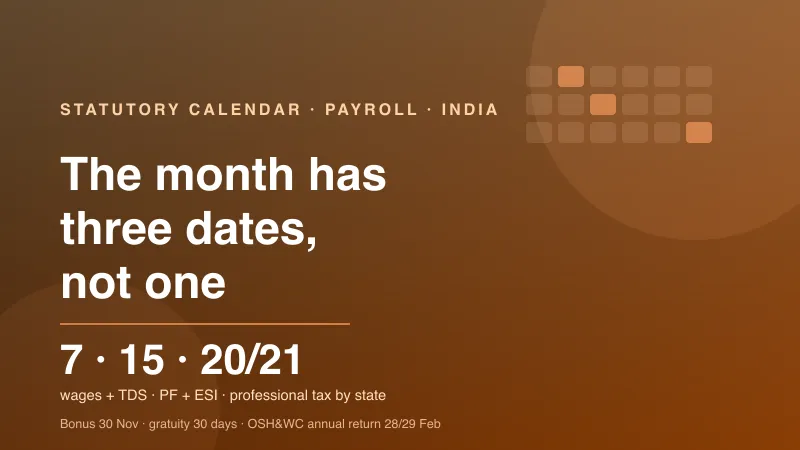
- Three dates run the month, not one: wages and salary TDS by the 7th, PF and ESI by the 15th, and professional tax on whatever day your state has chosen.
- Professional tax has no national date. It is the 10th in Telangana, the 15th in Maharashtra, 20 days after month end in Karnataka, the 21st in West Bengal, and half-yearly in Tamil Nadu and Kerala.
- The annual layer is small but expensive: bonus within eight months of the accounting year close (30 November for a March year end), gratuity within 30 days, the OSH&WC integrated return by 28 or 29 February.
- Dates are defaults, not guarantees. EPFO extended the September 2026 ECR deadline from 15 October to 31 October because the PF wage ceiling changed mid-month.
- Keep one register with a named owner, a form or portal, and an evidence line per obligation. Set the reminder five working days before the date, never on it.
The month has three dates, not one
The national calendar is shorter than most employers expect. Every central obligation falls on the 7th or the 15th of the following month.
| Obligation | Due | Who is liable | Where it is filed |
|---|---|---|---|
| Wages for the wage period | 7th of the following month (10th where 1,000 or more workers are employed) | Employer | Payment only, no return (Code on Wages, 2019, s.17) |
| TDS on salaries | 7th of the following month; March salaries by 30 April | Employer as deductor | Income Tax Department |
| Salary TDS statement | 31 July, 31 October, 31 January, 31 May | Employer as deductor | Form 138 (earlier Form 24Q) |
| PF contribution and ECR | 15th of the following month | Employer | EPFO unified portal |
| ESI contribution | Within 15 days of the last day of the calendar month | Employer | ESIC |
| Wages to contract labour | 7th day after the end of the wage period | Contractor | OSH&WC (Central) Rules, 2026, Rule 98 |
| Full and final settlement | Within two working days of removal, dismissal or resignation | Employer | Code on Wages, 2019, s.17(2) |
Two things follow from that table. The first is that the 7th is a harder date than the 15th. Wages have to be paid by the 7th, which means the payroll run, the bank file and the TDS deposit all have to land in the same week. A payroll that closes on the 25th for a month ending on the 30th has six working days to absorb joiners, exits, overtime and a bank failure. That is the real constraint behind most late PF deposits.
The second is that the 15th is a single date for two schemes with different bases. PF runs on the statutory wage ceiling, which rose from ₹15,000 to ₹25,000 a month with effect from 17 September 2026. ESI runs on a ceiling of ₹21,000 in most states. Both are due on the 15th, both are computed from the same salary register, and both will be wrong together if the wage base is wrong. The EPF and ESI references carry the rates and the split.
The month that proves the point
September 2026 is the useful example, because EPFO moved its own deadline. The ECR for September was extended from 15 October to 31 October to give employers time to apply the new ceiling. September payroll then had to be apportioned at 16 September: the old ceiling for 1 to 16 September, the new one for 17 to 30 September, both reported in a single ECR. An employer whose calendar held only “PF: 15th” either filed a wrong return on time or found out about the change from the portal on the 14th.
The state layer: professional tax has no national date
Professional tax is the obligation most likely to be wrong in a multi-state payroll, because there is nothing national about it. Article 276 of the Constitution lets states tax professions, trades, callings and employments up to ₹2,500 a year per person (Constitution of India), and each state then writes its own slabs, its own collection cycle, its own return and its own portal. The tax follows the place of work, not the head office, so five offices mean five calendars.
| State | Cycle | Employer deposit | Return or statement |
|---|---|---|---|
| Andhra Pradesh, Telangana | Monthly | 10th of the following month | Form V with payment (Telangana) |
| Maharashtra | Monthly if PT liability is ₹1,00,000 or more | 15th of the month (moved from month end on 28 February 2026) | PTRC return; annual filers by 15 March |
| Karnataka | Monthly | Within 20 days after the month ends | Form 5-A; annual return by 30 May (Karnataka PT) |
| Gujarat | Monthly at 20 or more staff, quarterly below | Within 15 days of the period end | Form 5 with the deposit |
| Madhya Pradesh | Monthly | Within 10 days after the month ends | As prescribed in the rules |
| West Bengal | Monthly | 21st of the following month | Annual Form III by 30 April |
| Tamil Nadu | Half-yearly | Before 30 September and 31 March | Forms 14 and 15 before payment (Chennai) |
| Kerala | Half-yearly | End of August and end of February | Salary statement on the local body’s demand |
| Bihar | Annual | Deduct from September salary, deposit by 15 November | PT-VIII by 30 November |
| Jharkhand, Sikkim | Quarterly | Within 15 days of the quarter end | Quarterly return with payment |
Two rows deserve a note. Karnataka sets its date in days, not a day of the month: section 6A requires the statement and the tax within 20 days after the month ends, which lands on the 20th for a full month. And Bihar is the outlier that catches people who assume every state collects monthly: the whole year’s deduction is taken once, from September salary, and paid in November.
Some states do not levy professional tax at all: Delhi, Haryana, Uttar Pradesh, Rajasthan, Uttarakhand, Himachal Pradesh, Goa, Chhattisgarh and Jammu and Kashmir. Odisha joined that list on 1 April 2026, when its professions tax Act was repealed, so any Odisha deduction in the 2026-27 payroll belongs to the employee and should be refunded. Punjab collects a State Development Tax of ₹200 a month instead. Our professional tax reference covers slabs and exemptions.
There is also a second, quieter professional tax date that belongs to the company rather than its staff: the enrolment certificate. A company, firm or professional pays its own PT once a year, on dates that differ from the employer’s. Those dates are 30 April in Karnataka, 30 June in Andhra Pradesh, Telangana and Jharkhand, 31 July in West Bengal, 30 September in Gujarat, Madhya Pradesh, Assam, Sikkim and Tripura, and 30 November in Bihar. It falls in a quiet month, which is exactly why it gets missed, and arrears surface years later during a tender or licence application that asks for a PT clearance.
The labour welfare fund: small amounts, awkward calendars
The labour welfare fund is a state contribution of a few rupees per employee, and it is the item most often missed simply because the amount looks too small to matter. It operates in about sixteen states, and the frequency is not consistent: monthly in Haryana, half-yearly in Maharashtra, Gujarat, West Bengal, Delhi, Madhya Pradesh, Chhattisgarh and Odisha, and annually in Karnataka, Tamil Nadu, Andhra Pradesh and Telangana. Punjab and Chandigarh deduct monthly but deposit half-yearly.
| State | Frequency | Due |
|---|---|---|
| Maharashtra | Half-yearly, deducted in June and December | 15 July and 15 January |
| Karnataka | Annual, deducted in December | 15 January |
| Tamil Nadu | Annual, deducted in December | 31 January |
| Andhra Pradesh | Annual | 31 January |
| Telangana | Annual | 31 January |
| Delhi | Half-yearly | 15 July and 15 January |
| Gujarat | Half-yearly | 15 July and 15 January |
| West Bengal | Half-yearly | 15 July and 15 January |
| Haryana | Monthly | 15th of the following month |
Rates are set by each state board and have moved repeatedly: Maharashtra and Karnataka both revised their Acts in 2024, and Haryana indexed its employee cap again on 1 January 2026 to ₹35, with arrears possible for the months before the notification was issued in May. The LWF reference carries the amounts, and the state board’s portal is the authority before you build a line into the register.
Coverage moves too. Karnataka’s Act now applies to establishments with 10 or more persons, down from 50, with effect from 7 January 2026. That brings a large number of Bengaluru offices into the fund for the first time, and their first contribution is due by 15 January 2027. An employer who assumed the fund did not apply because the headcount was under 50 will find the liability waiting on the next January date.
The annual layer: bonus, gratuity and the returns
The annual obligations are few, and each one has a clock rather than a fixed date, which is why they surprise employers who work from a list of dates.
| Obligation | Clock starts | Due | Source |
|---|---|---|---|
| Bonus payment | Close of the accounting year | Eight months later, so 30 November for a 31 March year end | Payment of Bonus Act, 1965, s.19 |
| Bonus annual return | After payment | Form D, as the rules prescribe | Payment of Bonus Rules, 1975, Rule 5 |
| Gratuity | Date it becomes payable | 30 days, then simple interest at the notified rate | Payment of Gratuity Act, 1972, s.4(2), s.8 |
| OSH&WC integrated annual return | Calendar year | 28 or 29 February | OSH&WC (Central) Rules, 2026, Rules 72 to 76 |
| ESI annual information | Calendar year | 31 January | Form 01A with the regional office |
| State returns (factories, maternity, minimum wages) | State rules | Dates vary by state | See the checklist |
The bonus date is the one that costs most, because it is the one an employer is most tempted to move. Eight months from the close of the accounting year is 30 November for an establishment whose year ends on 31 March, and it is a payment deadline, not a filing deadline. The amount itself is capped at ₹7,000 of salary for calculation, with a floor of 8.33% and a ceiling of 20% (bonus reference). Two things usually go wrong: the return is filed and the payment is late, or the contract workforce is left out. Where a contractor fails to pay the minimum bonus to contract workers, the principal employer is liable once the failure is notified and confirmed (Code on Wages (Central) Rules, 2026, Rule 21), which puts a set of workers on your calendar who never appear on your payroll.
Gratuity is the opposite case: a clock that starts on the exit date and runs for 30 days. An employee who resigns in a month when the payroll team is closing the year is the one whose gratuity attracts interest, and interest is not recoverable from anyone. The 240-day rule also means the eligibility date is not always the anniversary you expect, which is why the gratuity list should be rebuilt from service records each quarter rather than once a year.
The fourth clock: notifications that move the base
Every date above assumes a wage base. The base moves twice a year, on a schedule, and it moves for a subset of employers at a time.
In the central sphere the Ministry of Labour revises the variable dearness allowance effective 1 April and 1 October, publishing the average CPI-IW for the preceding six months and the revised VDA per area and category. The October 2026 orders report the average CPI-IW at 431.42 against 424.80 on 30 June 2026, an increase of 6.62 points (Labour Bureau VDA orders, October 2026). States run their own cycle: Maharashtra notified its special allowance for the half-year from 1 July to 31 December on 5 August 2026. The VDA guide explains how the index becomes a number.
The consequence for the calendar is direct. A VDA revision raises the wage floor, which raises the basic and DA on which PF, ESI, bonus and gratuity are computed, which changes the amount on the 15th challan, and which invalidates any contract rate agreed before the notification. A payroll calendar that tracks dates but not notifications ends up paying the right amount to the wrong base for a quarter at a time.
The 2026 record shows how often this happens:
- EPF wage ceiling raised from ₹15,000 to ₹25,000 with effect from 17 September 2026, with the September ECR deadline extended to 31 October.
- Maharashtra professional tax moved to the 15th of the month by an amendment to Rule 11(3) notified on 28 February 2026.
- Odisha professional tax repealed with effect from 1 April 2026.
- West Bengal new salary slabs from 1 October 2026 payroll.
- Karnataka labour welfare fund threshold cut from 50 to 10 persons from 7 January 2026, and enrolled persons who pay now treated as having filed their annual return.
None of those changes alters the idea of a calendar. Each one alters a line in it. That is why the register needs a column for the notification, not just the date, and why the first working day of April and October is the right time to re-read every line.
The event layer: obligations that start on a trigger
A fifth category of deadline has no date at all until something happens. These are the ones an inspection asks about, because they show whether compliance is a system or a filing habit.
| Trigger | Obligation | Clock |
|---|---|---|
| New joiner | UAN, ESI registration, PT enrolment, LWF register date, nominations | Before the first salary is paid |
| Exit | Full and final settlement, PF and ESI exit formalities, gratuity where eligible | 2 working days for wages, 30 days for gratuity |
| New contractor | Licence verified, work order intimated, register of contractors updated | Before deployment |
| Accident | ESI report, factory notice, BOCW report where applicable | Immediately, 48 hours, or 4 and 72 hours depending on the statute |
| Inspection | Documents produced, defects rectified within the window | 30 days under the OSH&WC Code, s.110 |
The new-joiner row is the one with a compounding cost. A worker who starts on the 2nd of the month with no UAN and no IP registration is a worker whose PF and ESI will be filed late or short. The arrears follow that worker for as long as the omission stays open. The check that catches it is a headcount reconciliation between the attendance register and the contribution return, done before the ECR is filed rather than after.
How to build the register
The calendar itself is a table. A statutory compliance register is that table made accountable: every payment and filing an employer owes a regulator, with a named owner and a piece of evidence against each line. What makes it work is that it is reconciled rather than trusted.
| Column | What goes in it |
|---|---|
| Obligation | The payment or return, named precisely |
| Authority and portal | EPFO, ESIC, state PT portal, state welfare board, Income Tax |
| Cycle and date | Monthly, quarterly, half-yearly, annual, event-driven, and the date or rule that sets it |
| Trigger | The act that starts the clock, where the date is not fixed |
| Owner | One named person, not a department |
| Evidence | Challan number, acknowledgement, filed date and the payroll month it belongs to |
| Notification | The order or circular that currently governs the row, with its date |
| Penalty | What a miss costs, so the row can be prioritised |
Six rules keep that table honest:
- One owner per row. A row owned by “HR and finance” is owned by nobody, and it will be the row that fails.
- File the evidence with the payroll month. A challan number in a folder with no month attached cannot answer an inspection two years later.
- Set the reminder five working days before the date. Most state portals treat a payment as made when it reaches the treasury, and bank gateway failures cluster on the last day.
- Reconcile before filing. PT deducted per payslips should equal PT paid per challans, state by state, every month. PF and ESI headcount should equal the attendance register. Differences come from joiners, leavers, slab changes and challans paid under the wrong period, and they are cheap to fix in the month they occur.
- Re-read the notifications in April and October. Those are the months wage floors and state rates move.
- Audit the contractor’s calendar separately. A contractor files their own ECR, PT and LWF. Ask for the challans, not the assurance, at renewal and at any change of subcontractor.
What a missed date actually costs
The statutory consequences are covered in detail in the PF and ESI guide, so a summary is enough here. Late PF deposit attracts interest at 12% a year plus damages of 5% to 25% of the arrears (EPFO). Late ESI payment attracts interest and damages on the same pattern. Professional tax adds state interest, commonly 2% a month in Telangana and Andhra Pradesh and 12% a year in Gujarat, plus late-return fees such as ₹200 within 30 days and ₹1,000 after that in Maharashtra. Failure to maintain registers or file returns under the OSH&WC Code carries ₹50,000 to ₹1 lakh.
The commercial cost is usually larger. A late ECR in a month when the ceiling changed produces a short deposit, a re-run, employee questions about a passbook that does not match the payslip, and a corrections cycle that can run for months. A missed Odisha deduction in 2026 is money withheld from employees that has to be given back through payroll. A missed PT clearance surfaces during a tender, at the worst possible moment.
The bottom line
The calendar is not the hard part of compliance; the wage base, the thresholds and the principal-employer liability are. But the calendar is where the failures show, because a date cannot be interpreted. Build the register once, put a name against every row, attach the notification that governs it, and review it in April and October. The rest of the work, from the contribution rates to the returns, is already documented in the compliance reference and the labour codes overview.
Our payroll service runs the statutory calendar as one register across states, reconciles the deductions to the challans each month, and keeps the acknowledgement trail per payroll run. The labour cost calculator applies the statutory rates to your own wage figures before you commit to a contract rate. If you are consolidating a multi-state payroll or replacing a vendor, send us the states, headcount and current filing status and we will set out the dates and documents you are actually on the hook for.
Frequently asked questions
Is there one national date for statutory payments?
No. Central obligations fall on the 7th (wages and salary TDS) and the 15th (PF and ESI). Professional tax and the labour welfare fund are set by each state, with dates from the 10th to the 21st, half-yearly cycles in Tamil Nadu and Kerala, and an annual cycle in Bihar. Bonus and gratuity are event clocks rather than dates.
What is the professional tax due date if we operate in several states?
There is no single date, and the tax follows the place of work rather than the head office. In 2026 the employer deposit is due by the 10th in Telangana and Andhra Pradesh, the 15th in Maharashtra, and within 20 days of month end in Karnataka. Gujarat is 15 days after the period end, West Bengal is the 21st, and Tamil Nadu and Kerala collect half-yearly. Each state also has its own return form and portal.
When is statutory bonus due?
Within eight months of the close of the accounting year, which is 30 November for an establishment whose year ends on 31 March. The payment is mandatory for eligible employees, and the amount is calculated on salary capped at ₹7,000 a month with a floor of 8.33% and a ceiling of 20%. The annual return follows the payment.
Does the 15th apply to contract workers deployed at our site?
Not directly. The contractor files the ECR and the ESI return for their own workers, and pays their wages by the seventh day after the wage period ends. Your obligations run alongside: you are liable for unpaid wages if the contractor fails, and in the case of the minimum bonus, once the failure is notified and confirmed. Verify the contractor’s challans at renewal rather than assuming the dates are being met.
Can we pay a day or two late?
No scheme treats lateness as harmless. PF carries 12% interest plus damages, ESI adds interest and damages, and professional tax adds state interest and late-return fees. Interest is usually charged per month or part of a month, so a payment on the 2nd of the following month can cost a full extra month. Pay the tax and interest together, then file the return.
Do the labour codes change these dates?
The codes consolidated the statutes but kept the operating calendar. PF and ESI contributions still fall due on the 15th, bonus still runs on eight months, and professional tax and the welfare fund remain state levies. What the codes changed is the wage base, the definitions, and the penalty scale, which is why the labour codes overview is the right companion to this calendar.
Send the requirement
If this post points at a decision you are close to making, send us the scope — sites, roles and shifts — and we will confirm the licence, supervision and commercial position for your situation.
Discuss your requirement