
Payroll errors and their real cost: penalties, arrears and inspection risk
What a payroll error actually costs a business — late-deposit interest and damages, unpaid statutory arrears, employee trust, and inspection exposure — and how to catch the expensive ones.
By Knighthood Team
Published 26 August 2026
Updated 14 October 2026
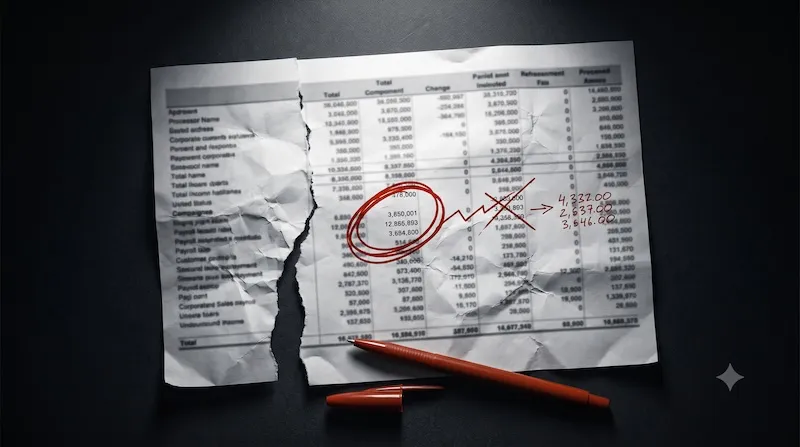
A payroll typo does not just mean one underpaid worker. Where payroll is statutory, an error compounds into interest, damages, arrears and inspection exposure. This post puts a number on what the common mistakes cost and where they come from. It matters more if you run payroll on spreadsheets, where an error can copy across an entire workforce in one formula. The payroll outsourcing vs in-house comparison is about the point where spreadsheets stop being the cheaper answer.
The quiet multiplier: the 15th
The single most expensive payroll failure is missing a statutory due date. PF and ESI contributions are both due by the 15th of the following month (EPFO employer filing, ESIC contributions, checklist, post-payroll). Miss it and the late money carries:
- Interest at 12% a year on the PF arrears, plus
- damages of 5% to 25% of the arrears depending on the delay (EPF and Miscellaneous Provisions Act, 1952, PF).
Interest and damages scale with the amount and the delay, so a consistent pattern of filing a day late quietly builds a penalty line. The due date is not a soft target; it is the control that keeps payroll cheap.
The line that turns a mistake into an offence
There is one specific error the authorities do not treat as an accident: deducting an employee’s contribution and not depositing it. PF and ESI are deducted from wages on the employee’s behalf. If the deduction is collected and the deposit does not reach the fund, that is treated as the employer withholding the employee’s money, and it is a criminal offence under the PF Act (PF). A cash-flow problem that borrows the employee’s PF to cover wages has turned a payroll error into a legal one.
Underpayment and arrears
Paying below what is due shows up in three places. The first is minimum wages: pay below the notified rate for the state, skill level and employment, or structure it so basic falls under 50% of total wages, and that is underpayment, an offence under the Minimum Wages Act, 1948 with fines and imprisonment for repeat cases (minimum wage, labour codes). The second is statutory base understatement — building a salary with basic at 40% so PF, ESI, bonus and gratuity are calculated low. Under the Code on Wages, 2019 the fixed allowance counts as wages, so the base is higher and the contribution arrears build retrospectively. The third is a simple arrears claim: when an employee or an inspector catches a short payment, you owe the difference, and the worker usually claims it with interest and damages attached.
The costs that do not appear on a challan
Beyond penalties, an error spends down the things that are hard to price: an inspector flagging your registers, a worker leaving over a wrong payslip, a contract dispute over an understated statutory component. Inspection exposure is the one that compounds. The authorities can test your wage structure against the wage definition and your registers against the actual payments (checklist). If the books do not match the payroll, every site becomes a risk, not just the one with the error.
Where the expensive errors actually come from
The mistakes that cost the most share a pattern — they are data or structure errors, not arithmetic:
- Stale inputs — attendance, leave and new hires not captured before the run (attendance and leave).
- State variation ignored — professional tax slabs, minimum wages and welfare fund rates copied across states that differ.
- The basic-wage ratio wrong — building the structure to hide money from the statutory base, which the Wage Code now folds back in.
- The ceiling mishandled — the PF ceiling (₹25,000) and the ESI ceiling (₹21,000) confused, or the EPS cap ignored when it redirects money to the employee’s account (PF, ESI).
- Deducting and depositing in the wrong order — collecting the employee’s share, then leaving the deposit late.
Catching the expensive ones
A few controls do most of the work. Reconcile the payroll against the prior month before payment, so a spike or a gap is visible rather than shipped (post-payroll). Validate inputs before the run, so errors do not enter the calculation. Build basic at 50% and track statutory dates against a calendar you actually watch. Where running this in-house on spreadsheets has already produced an error or two, a payroll service carries the run on a fixed calendar with a documented audit trail, and corrections are recorded rather than silently edited.
The bottom line
Payroll errors are cheap to prevent and expensive to carry. Miss the 15th and you pay interest and damages. Understate the wage base and you owe arrears. Deduct and fail to deposit, and you have a compliance matter that is criminal, not clerical. Build the inputs, the structure and the calendar right, and most of the cost cases never arise.
Frequently asked questions
What happens if I deposit PF a few days late?
The deposit still lands, but it carries interest for the delay and exposes the establishment to damages, which scale with how long the money sat. Individually the amount may look small; the real problem is the pattern, because a payroll that runs late every month accumulates a liability that a single inspection will total up. Fix the calendar before the amount grows.
Which payroll error is the most serious?
Deducting the employee’s contribution and not depositing it. Once the money has been collected from wages, it is being held on the employee’s behalf, and failing to pass it on is treated as a criminal matter rather than an accounting one. No cash-flow crunch justifies it — the correct move is to prioritise the statutory deposit over other payments.
How do I catch errors before the salary is paid?
Reconcile the run against the previous month line by line before disbursement: headcount, gross, deductions and net, with attention to anyone whose number moved by more than a normal variation. Validate the inputs first — attendance, joiners, exits, leave — because almost every expensive error enters as bad data rather than as a calculation mistake. Two checks before payment beat any amount of correction after it.
What is the penalty for paying below the notified minimum wage?
Paying less than the notified rate is an offence, and the exposure includes a fine and, for repeat offences, imprisonment, along with the arrears owed to the worker. The same logic applies when a salary is structured so that basic falls below the statutory share of wages — the underpayment is real even though the payslip was issued on time.
Can I correct a payroll error after salaries have been paid?
Yes, and you should, promptly and in writing. Recover or pay the difference in the next cycle, record the correction against the affected employee, and keep the note with the payroll records. What you should not do is edit the earlier run silently — an unexplained change in the books is worse in an inspection than the original error and the correction together.
Is outsourcing cheaper than fixing errors in-house?
The honest comparison is your current run against a provider’s fee, including your own time, the software and the risk of one expensive mistake. Payroll services are priced to be cheaper than a single late-deposit penalty in most mid-sized operations, which is why the argument rarely turns on the subscription cost. Get both numbers, including the cost of the last error you had.
Send the requirement
If this post points at a decision you are close to making, send us the scope — sites, roles and shifts — and we will confirm the licence, supervision and commercial position for your situation.
Discuss your requirement