
Facility management services in India: the buyer's guide
A facility management contract is a labour contract with a supervision layer, priced at a margin thin enough that no vendor can absorb a badly written scope. Here is what an FM contract actually buys, how it is scoped and priced, what compliance travels with it, and how to compare bids that were never for the same job.
By Knighthood Team
Published 27 October 2026
Facility management is the outsourced running of a building’s services — cleaning, upkeep, technical maintenance and the supervision that holds all of it to a written scope. In India it is usually bought as a monthly manpower rate, delivered under a contract that runs for years, and judged against a standard nobody wrote down. Those three things together are why so many FM contracts end up in the same place: the work is broadly happening, nobody can prove it, and the invoice goes up every year without the scope going up with it.
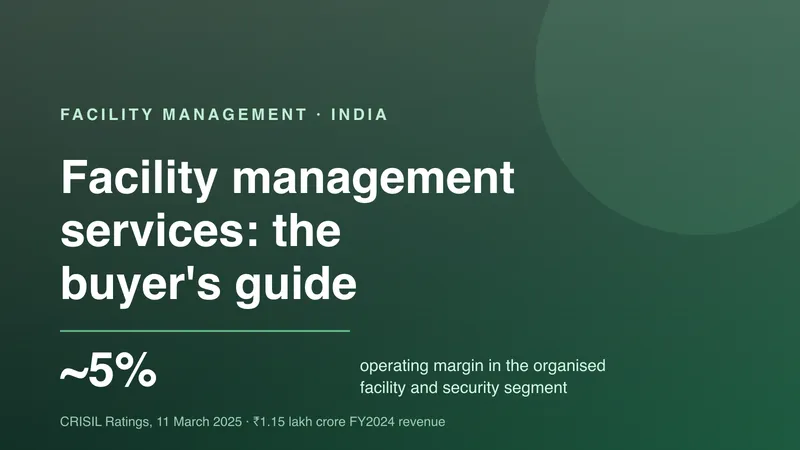
The market is not the problem. The organised security and facility management segment earned about ₹1.15 lakh crore in FY2024, grew at a compound 13% over the four years to March 2025, and was expected to add another 10–12% in FY2026 (CRISIL Ratings, 11 March 2025). Supply is not the problem either. The problem is that operating margins in that same segment run at about 5%. A vendor working on a 5% margin has almost nothing to absorb with: a scope you left ambiguous, a headcount you under-specified, or a wage revision you did not plan for all land on the same thin line. One of them will be resolved by cutting the thing you cannot see.
This guide covers what an FM contract actually buys, how to scope it so the work is inspectable, how the monthly value is built up, what compliance travels with the contract whether you notice it or not, and how to compare bids that are rarely for the same job. It is written for the person who signs the contract and the person who has to live with it. The service itself is described on the facility management page.
Key takeaways
- Facility management is three things, not one: soft services, hard services, and the supervision and records that make both of them inspectable. A contract with only the first two is a list of vendors with one invoice.
- The wage bill is the contract. Statutory contributions come to roughly a quarter to a third on top of the notified wage before any service charge, so a bid that undercuts the field by 20% is cutting headcount, wage rate, supervision, consumables or compliance — there is no sixth place for it to come from.
- Two credible bids for the same building differ because the scopes differ. Ask for the build-up, then compare line by line against the notified minimum wage for the role and state.
- Attendance proves presence, not service. Completion against the schedule, verified by inspection, is the only measure that survives a change of supervisor.
- After the CLRA repeal, welfare and wage obligations for contract labour sit with the principal employer from ten employees, and the contractor needs a licence at 50 contract workers. An FM contract carries that exposure even when the work is entirely someone else’s staff.
What facility management covers, and what it does not
Facility management splits into soft services and hard services, and the split matters commercially because the two are priced on different things. Soft services are labour-heavy and priced per person and shift. Hard services are asset-heavy and priced on an annual maintenance charge plus spares, skilled technicians and the downtime you are willing to accept.
| Service family | Typical scope | What the price is built on |
|---|---|---|
| Soft services | Housekeeping and janitorial, pantry and cafeteria, pest control, landscaping and grounds, waste collection and segregation, front-office and support staff | Headcount, shifts, frequency, consumables |
| Hard services | HVAC (chillers, AHUs, cooling towers), electrical (HT/LT, DG, UPS), plumbing and STP, lifts and escalators, fire detection and suppression, civil upkeep and painting | Asset inventory, AMC, spares, technician skill, statutory inspections |
| The operating layer | Supervision, inspection, escalation, completion and exception reporting, statutory records | Number of sites per supervisor, reporting cadence |
In most Indian FM contracts the headcount sits overwhelmingly on the soft side, while the biggest single line in the value can be a hard service the buyer never looks at. That asymmetry is exactly why a blended rate per square foot is such a poor instrument: it hides which half of the service is failing, and it gives the vendor an obvious place to recover a thin margin, which is the half you cannot see.
Three things sit outside the scope in most contracts, and it is worth saying so explicitly rather than discovering it during a breakdown:
- Capital repairs and replacement. Replacing a chiller, rewiring a floor or resurfacing a driveway is capital work. Some providers will manage the project; none will fund it out of a monthly service charge.
- Utilities and statutory ownership. Electricity and water accounts, consents to operate and the legal duty to maintain a safe building stay with you as the owner or occupier. An FM provider operates the asset; it does not become the licensee.
- Work that has no written standard. If the scope says “daily cleaning” without saying what done looks like, the delivered standard will settle at whatever the supervisor on site accepts.
The economics: you are buying labour with a supervision layer
Almost every FM invoice in India is a wage bill with statutory additions, a supervision cost, consumables and a service charge stacked on top. Understanding that build-up is the difference between negotiating and guessing.
| Line in the build-up | What it is | What makes it move |
|---|---|---|
| Wage (basic plus dearness allowance) | The rate paid to the housekeeper, technician or supervisor | State, zone, skill level, and the notified floor |
| Provident fund | 12% of basic plus DA, subject to the wage ceiling | Wage base and the ceiling in force |
| ESI | 3.25% of wages where the employee is covered | Gross wage against the coverage limit |
| Bonus, gratuity, LWF, professional tax | Statutory accruals and state levies | Eligibility, state, headcount |
| Reliever and absence cover | The people who cover leave, absence and attrition | Leave pattern, shift count, attrition |
| Supervision | Site supervisor and field officer time | Headcount per supervisor, sites per officer |
| Consumables and equipment | Chemicals, dispensers, machines, tools, spares | Usage, standard of clean, asset age |
| Service charge | Provider overheads and margin | Risk, payment terms, contract length |
The statutory block alone is not small. Added together, PF, ESI, bonus and gratuity come to roughly a quarter to a third of the wage before a supervisor is paid. The exact figure depends on how much of the wage sits in basic, because PF and gratuity are computed on basic while ESI runs on gross, and the Code on Wages rule that basic must be at least half of total wages is what stops a provider shrinking that base to save money. A compliant contract therefore rarely looks cheap against an informal one. The minimum wages guide sets out the build-up line by line, and the labour-cost calculator applies it to your own wage figure and state.
Two consequences follow, and they explain most of what buyers find confusing about FM quotes.
The first is that the market price is a wage floor plus a margin, not a discount on a list price. If a bid comes in materially below the field for the same headcount and the same frequency, the gap has to come from one of five places: fewer people than the roster says, a wage below the notified rate, less supervision, cheaper consumables, or statutory contributions that are not being paid. The last of those is not a saving. It is a liability that passes to you, which is the subject of the principal employer guide.
The second is that a 5% margin business cannot carry your ambiguity for free. Every unclear line in the scope is priced twice: once by the vendor that assumes the generous reading, once by the vendor that assumes the cheap one. Two bids that land far apart are usually both honest, and they are not quoting the same building.
Four ways to buy the same service
There is no single right structure. The choice turns on how much coordination you want to own and where you want the risk to sit.
| Model | What you buy | Who coordinates | Fits when | Breaks when |
|---|---|---|---|---|
| In-house team | Staff on your payroll, your supervisor | You | One site, stable scope, work close to your core | Headcount grows past one supervisor, or attrition becomes a second job |
| Single-service vendors | One contract per service: cleaning, pest, HVAC, landscaping | You, across several vendors | Services have genuinely different specialists and you have facilities staff to manage them | No one owns the result; a leak is the plumber’s fault until it reaches the electrician |
| Bundled multi-service | Several services under one provider, separately scoped | Provider, with you reviewing | You want fewer invoices but still want each service visible | The bundle becomes a blended rate nobody can unpick |
| Integrated facility management | One accountable owner for the full facility scope, with a written standard | Provider, under your governance | Multi-site operations, or a site with no facilities manager of its own | The scope is vague, so integration just hides the gaps faster |
Integrated facility management (IFM) is the model this guide spends most of its time on, because it is the one that fails most expensively when it is badly specified. Integration is not a discount for volume. It is a transfer of coordination: one supervisor, one escalation path, one monthly review, one set of records covering cleaning, maintenance and the vendors who remain outside the scope. What you give up is the ability to compare each service against the open market every year. What you get back is a single person who can be asked why the third floor was not cleaned. The IFM explainer covers the soft versus hard split and the bundles that pass for integration.
The intermediate option is worth considering before going full IFM: bundle the services that share a supervisor and a shift, and keep the genuinely specialist contracts separate. Cleaning, pest control and pantry share people, hours and consumables. Lifts and fire systems do not, and folding them in usually means paying an integrator to manage a subcontractor you could have contracted directly.
Writing a scope you can inspect
A workable scope has three columns: the area, the frequency, and the standard that counts as done. Two of the three are usually written. The third is usually not, and it is the only one that decides whether you have a dispute in month four.
| Area | Frequency | What counts as done |
|---|---|---|
| Reception and entrance | Daily, plus a mid-day reset | Floors free of marks, glass clean, no odour, visitor seating reset |
| Workstations and floors | Daily | Bins emptied, floors mopped, desks left clear, no dust on sills |
| Washrooms | Twice daily at minimum, more on footfall | Consumables stocked, surfaces sanitised, no standing water, extractor running |
| Pantry and cafeteria | Daily, plus a deep clean on a set cycle | Surfaces degreased, bins empty, equipment cleaned inside the schedule |
| Meeting rooms | Daily and after each booking | Reset to the standard you would show a client |
| Carpets, upholstery, façade, high level | Periodic, on a dated calendar | Deep clean completed on schedule, not on complaint |
| DG, UPS, pumps, AHUs | On the maintenance schedule | Log filled, readings taken, defects raised in writing |
| Lifts and fire systems | Statutory inspection plus AMC | Certificate current, AMC visit logged, defects closed |
Underneath that table sit the operating clauses that decide whether the table is delivered. Six of them are worth writing even when the provider says they are standard:
- Supervision. Who inspects, how often, on which shift, and whether the supervisor is on site or covers four sites by car. A cleaning contract with no named supervisor is a contract with no standard.
- Absence cover. What happens when two housekeepers do not turn up. If the answer is “the work waits”, the building degrades within a fortnight.
- Consumables. Who buys, who stocks, who counts, and what happens when a dispenser runs dry mid-week. This single line accounts for a surprising share of FM complaints.
- Escalation. A named person, a phone number and a response time for each level, not a ticket queue.
- Records. What is written down, in what format, and for how long. Completion records are also your defence if a statutory inspection asks what was done and when.
- Exit and transition. Notice period, handover of records, treatment of staff, and the state the building is handed back in. Exit terms you did not read are the reason buyers stay with a provider they no longer want.
One more clause belongs in the contract even though it is not a service: the wage and statutory proof you are entitled to see. Ask for the wage register extract and the EPF and ESI contribution evidence for the deployed staff, at least quarterly. A provider that cannot produce it is either not paying or not recording, and both become your problem under the labour codes.
The service levels that survive contact with a real building
Most FM service level agreements fail for the same reason: they measure what is easy to log rather than what the buyer actually needs to know. Attendance data is the classic case. It tells you someone clocked in. It does not tell you the washroom was cleaned, the pump was serviced, or the escalator was inspected.
Five measures carry most of the value:
- Completion against the schedule. Of the areas and tasks scheduled for the month, how many were completed and recorded. This is the base measure, and it is only meaningful if the schedule has dates.
- Complaint response and closure. Time to acknowledge, time to close, and how many were closed on the first visit. A high first-visit closure rate is the single best sign that the supervisor is actually supervising.
- Inspection score against the standard. A short scored walkthrough on a fixed cadence, on a rotating area, with the misses written down. Scores that only ever rise are not being taken.
- Recurring defects. The same fault three times in a month is a maintenance problem, not a housekeeping one, and it should escalate on the third occurrence rather than the tenth.
- Attendance reconciled to the roster. Deployment should match what you pay for, headcount and shift. This is an integrity measure, not a service measure, and it is the first thing to check when a contract feels overstaffed on paper and understaffed at 8am.
The governance around those numbers matters as much as the numbers. A daily exception call, a weekly review with the site supervisor and a monthly service review with a named account owner is enough for a single site. What does not work is an elaborate scorecard that nobody fills in. The KPIs and SLAs guide takes these five measures into a full scorecard: severity clocks, credit sizing, inspection sampling and the one-page monthly pack. Our facility management service page sets out the reporting cadence we commit to, and the field supervision benchmark explains how supervision coverage is planned rather than assumed. The operating visibility layer is where attendance, deployment and exceptions are reported against the same roster.
How an FM contract is priced, and what moves the number
Indian FM contracts are priced in one of three ways, and the difference is who carries the risk of the work being harder than expected. The cost guide works through the build-up line by line, including the relief cover a round-the-clock post actually needs.
- Man-day pricing bills for people: so many housekeepers, so many shifts, at a rate per person-month. You carry the volume risk and the quality risk. It suits a fixed roster and a stable building.
- Output or area pricing bills for the result: a rate per square foot, or a fixed monthly value for a defined standard. The provider carries the productivity risk. It suits a site where coverage, not headcount, is the point, provided the standard is written tightly enough to be enforced.
- Managed service pricing bills for the outcome and the operating layer together: scope, supervision, technology and reporting in one fee. It suits multi-site buyers who want one accountable owner and are willing to pay for governance rather than only for labour.
The pricing model comparison sets the three side by side, and how pricing works explains what a credible build-up looks like. Whichever model you choose, five things move the monthly number, and only one of them is negotiation:
- Wage revision. Minimum wages are revised by notification and moved between revisions by variable dearness allowance. A contract with a fixed rate and no escalation mechanism does not survive the first revision; either the provider absorbs it, which a 5% margin cannot do, or the service quietly thins. Write the escalation as a formula tied to the notified rate for the role and zone, with the notification as the trigger. The wage notification guide shows how that rate is built, and how VDA works explains why the number moves between revisions.
- Headcount and shift pattern. A 24×7 desk is not one person. It is at least four, because weekly offs, leave and absence all have to be covered by someone who is already counted in the roster.
- Consumables and periodic work. Deep cleans, façade access, carpet shampooing and pest cycles are usually quoted separately because their frequency is a choice, not a constant.
- Contract length and payment terms. Longer terms with predictable volumes price better than 30-day payment on a three-month trial. Retention and penalty clauses are priced in too, whether the vendor mentions them or not.
- Taxes and statutory changes. Any rate quoted is exclusive of what the statute adds later, which is one more reason the escalation clause should reference the notification rather than a percentage the parties invent.
The compliance that travels with the contract
Facility work is contract labour, and contract labour in India is now regulated by the OSH&WC Code, 2020 rather than the repealed CLRA. Two thresholds decide how much of it lands on you: establishment registration and welfare duties apply from ten employees, and the contractor’s licence is triggered at 50 contract workers (contract labour compliance). Welfare facilities for contract workers are now the principal employer’s obligation, not a fallback when the contractor fails. In an FM contract, that headcount is the whole housekeeping and pantry team.
Five checks belong in procurement, not in the vendor’s back office:
- Wage floor. Every deployed role must be paid at or above the notified rate for that state, zone and skill level, under the Code on Wages, 2019. A bid built below the floor is a wage liability waiting to be transferred.
- PF and ESI. Contribution evidence for the deployed staff, not a certificate of registration. The PF and ESI guide covers what the evidence looks like and the compliance calendar covers the dates it should arrive by.
- Licences tied to the service. If security guards are inside the FM scope, the guarding provider needs a PSARA licence for each state it deploys in. The compliance and licences page sets out how a licence is read before you sign.
- Asset inspections you own. Lifts, fire systems, pressure vessels and diesel generators have their own inspection regimes, and an AMC visit is not a statutory inspection. An FM provider can schedule and evidence them; it cannot take the legal duty off you.
- Insurance. Workmen’s compensation cover for deployed staff and public liability for the site. Ask for the policy, the sum insured and the expiry date, and diarise the renewal.
The reason this belongs in the contract rather than in a compliance folder is arithmetic. The statutory layer is roughly a quarter to a third of the wage bill. If a provider does not pay it, the saving is real and immediate, and the cost arrives later, in an inspection, a claim or a worker’s complaint, addressed to the principal employer.
The first 30 days: what mobilisation should look like
Most of the risk in an FM contract sits in the changeover, not in year two. A provider that starts on day one without a baseline spends the first quarter discovering what the building actually contains.
A credible mobilisation runs in five steps, and you should be able to see evidence of each:
- Assess. A walkthrough that records areas, current frequency, staffing, assets, defect history and the gaps you already knew about. The output is a baseline you both agree on, in writing.
- Design. The scope, staffing structure, supervisory layer, reporting cadence, escalation matrix and compliance schedule for your site, not a template with your logo on it.
- Mobilise. Teams onboarded, staff vetted, equipment and consumables in place, inspections scheduled, incumbent staff transitioned without a coverage gap.
- Stabilise. The first month of completion records, exceptions and the early corrections. This is where an over-promised scope is quietly corrected, so watch what changes.
- Review. The first monthly service review against the baseline you set in step one. If the review compares performance to nothing, it will always conclude that performance is good.
Two things are worth watching closely in that sequence. The first is staff continuity: housekeeping staff who know the building are worth more than a marginally cheaper new team, and a changeover that loses the whole incumbent crew resets quality to zero. The second is the first scope change: how a provider handles the first requested change tells you how it will handle the twentieth. Our how we work page sets out the same sequence, and mobilisation and governance covers the transition and review cadence in detail.
How to compare bids that are not for the same job
You cannot compare a per-square-foot rate to a per-headcount rate. You can compare build-ups, if you ask for the same build-up from every bidder. Eight lines will surface almost every difference that matters.
| Check | What you are looking for |
|---|---|
| Headcount and shifts | Positions per shift, days per week, reliever included or not |
| Wage rate per role | Stated separately, and at or above the notified floor for your state and zone |
| Statutory lines | PF, ESI, bonus, gratuity, LWF and professional tax shown as separate amounts |
| Supervision | Named site supervisor or field officer, and the sites that person covers |
| Consumables | Item, grade and quantity per month, or explicitly excluded |
| Frequency | The same area and frequency grid as the other bidders, so the scopes match |
| Escalation | The formula, the trigger and the notice period |
| Exit | Notice, handover, records, staff treatment |
If a bidder will not provide those eight lines, the bid is not comparable, however familiar the total looks. Two practical habits make the comparison honest. First, score every bid against your scope document rather than against each other, so the cheapest wrong scope does not win. Second, hold a clarification round before you shortlist, and put the answers in writing as part of the contract. The vendor selection guide turns this into a working process, and the contractor audit checklist covers the due-diligence questions that belong before signature rather than after.
Buying mistakes that show up six months later
- Buying on rate per square foot alone. It is the easiest number to compare and the least informative. The same rate buys a daily clean and a three-times-a-week clean.
- Leaving “done” undefined. Without an acceptance standard, every dispute becomes an argument about judgement.
- Cutting supervision to protect the rate. Supervision is the line item buyers trim first and regret first. It is also the cheapest part of the contract per unit of risk removed.
- Handing consumables to the lowest bidder. Cheap chemicals and thin dispensers show up as complaints, replacements and rework.
- A fixed rate with no escalation mechanism. It looks like certainty and behaves like a slow service cut.
- Not looking at the wage register. The one document that tells you whether the bid is real.
- Forgetting the building’s statutory calendar. Lifts, fire systems and DG sets do not stop needing inspections because the contract changed hands.
Frequently asked questions
What is included in facility management?
Whatever the written scope says: typically housekeeping, pantry, pest control, landscaping, waste, and the maintenance of the building’s mechanical, electrical and plumbing systems, under one accountable contract with supervision and reporting. Capital repairs, utility accounts and the legal duties of the owner or occupier stay with you. Anything not written into the scope is not included, however obvious it seems on site.
What is the difference between facility management and housekeeping?
Housekeeping is cleaning and the related day-to-day upkeep of the premises. Facility management includes housekeeping but adds the hard services, the supervision layer and the reporting that covers the whole facility. The commercial housekeeping guide covers the cleaning-only scope in detail; the difference commercially is that FM carries asset and compliance responsibility as well as labour.
Is integrated facility management cheaper than separate vendors?
Not necessarily, and it is the wrong first question. Integration reduces the coordination cost you carry, and consolidates accountability for the result. Whether it reduces the total spend depends on whether your current contracts overlap, whether you have the staff to manage multiple vendors, and how well the integrated scope is written. A badly specified IFM contract is more expensive than three good single-service contracts, because the gaps become invisible.
How is a facility management contract priced in India?
Usually as a monthly value built from wages, statutory contributions, relievers, supervision, consumables and a service charge, quoted either per person-month or per square foot. Ask for the build-up rather than the rate, then test the wage line against the notified minimum wage for your state, zone and skill level. The labour-cost calculator shows what the statutory layer adds to a given wage.
Should we employ housekeeping staff directly instead?
Direct employment works for a single small site with a stable scope and one supervisor. Beyond that, the supervision, absence cover, replacement and statutory administration become a function in their own right, and one you are less equipped to run than a provider whose entire business it is. The question to ask is not which is cheaper per head, but who is accountable when the work is not done.
How do we know the work was actually done?
By inspecting against the written standard and keeping the record, not by judging the building on the way in. Two signals are reliable: whether consumables are always stocked without being chased, and whether the same complaint recurs. A recurring complaint usually means the specification is wrong rather than the cleaner being lazy.
Can security be part of the facility management contract?
It can be scoped together, and many buyers prefer one accountable owner across security and facility services. The licence does not merge, though: a guarding operation needs a PSARA licence per state regardless of who holds the FM contract, and the wage floors for security staff are set separately from housekeeping. Keep the scope integrated and the compliance evidence separate.
The bottom line
An FM contract is a labour contract with a supervision layer, and it is only as good as the scope behind it. Write the standard, price the build-up, check the wage and statutory evidence, and hold the provider to completion rather than to attendance. None of that requires a larger budget. It requires deciding, before signature, what “done” means and who can prove it.
If you are re-tendering a facility contract, or taking one over from an in-house team, send us the site list, the current scope and the last invoice. We will map what is actually being delivered today against what the contract says, and tell you where the two have drifted apart.
Send the requirement
If this post points at a decision you are close to making, send us the scope — sites, roles and shifts — and we will confirm the licence, supervision and commercial position for your situation.
Discuss your requirement